Ex-Hume-Ing the Truth

For all their differences, Descartes, Locke and Berkeley share one trait: they believe that it is possible to develop an argument that defeats skepticism and gives human knowledge a foundation of certainty. That optimism is not universal among philosophers, as David Hume makes clear in Enquiry Concerning Human Understanding. Hume is probably the most noted of the British empiricists, philosophers who (like Locke and Berkeley) believe that our knowledge comes primarily through our observation of the world around us and not from any inherent set of ideas or rational arguments. Where Hume differs from his fellows is in the amount of faith he’s willing to put into those empirical observations.
Continue reading “Ex-Hume-Ing the Truth”

Con Games

The worst thing about coming back from vacation is getting back to work. The best thing about coming back from vacation is telling people who didn’t go anywhere about what a great time you had. I figure if I combine the two and write a column about my vacation, I’ll come out somewhere in the middle and for once seem like a normal, well-adjusted fellow. At least till I get to the part about the four hour line for a sketch, but that’ll come in its own good time.

Now, Pattie and I have never taken a real extended vacation; the closest we’ve come is a weekend at a bed and breakfast. So this year we decided, to heck with it, we’re gonna fly somewhere on a jet plane, stay in a hotel, the whole nine yards. We both decided it would be cool — and pay attention here, because one reason I married this woman is that she would actually think this is cool — to fly out to San Diego for Comic-Con International, the biggest comic book convention in the world. Four days of comic buying, autograph getting, and watching people dress up like Jedi and stormtroopers. I had to promise her something about seeing the rest of San Diego while we were there, but I figured one day of cruising around California was a small price to pay for a visit to Graphic Art Nirvana.

Of course, first we had to get there, which is where the jet plane came in. Now, I am over six feet tall, and we were flying in coach. Despite this, and the fact that I booked the plane tickets, I forsake any hope of an aisle seat so that Pattie could sit by a window that may have been twice the size of my thumb and look at the clouds. As a result, I was slightly cramped during the six hour flight. Fortunately, I had my revenge, as the cramping resulted in my ankles cracking loudly for the rest of the day and night. Foley artists have recorded my ankles in order to better replicate the sound of a fierce thunderstorm, which can make trying to sleep in the same room with me an . . . interesting experience, to say the least. Cramping aside, the flight was fairly pleasant, the in-flight meal was actually pretty tasty, and everything was going along smoothly.

Until we started our descent, of course, and I experienced the most agonizing pain I can remember as my ears tried to deal with the change in air pressure. Ten sticks of Wrigley’s Spearmint did absolutely nothing to help me, and to make matters worse, I couldn’t hear a darn thing. Pattie would try and say something to me, and all I could do was shrug my shoulders. Now, a medical excuse to not hear any of your wife’s requests may seem like a good thing at first, but since we were on vacation there was no chance she was asking me to clean the dishes or take out the garbage, and besides, she’s a pretty good conversationalist most of the time. To say nothing of the fact that without any sense of hearing on my part, regulating the volume of my own voice was suddenly a challenge. Next time we fly, they’re gonna have to pull some kind of BA Baracus stunt on me, because I do NOT want to go through that again.

Anyway, we get to San Diego, and let me tell you, I’ve heard all sorts of claptrap about how the weather’s always perfect in San Diego, and it’s so beautiful, and the sun’s always shining, and I’m here to tell you it’s just not true. Just as an example, on Friday, I saw a cloud. It was one of those perfect, fluffy cumulus clouds, but still — it was a cloud. And I think the high temperature may have deviated by a degree or two during our five day stay. And once, for a moment, I think it may have been slightly humid before a breeze came in off the bay and took care of that. So really, we Northeasterners with our humid 100 degree summers and our slushy below freezing winters don’t have a thing to be jealous of, and I think those Southern Californians should just stop fooling themselves.

I’m running out of room here — why do I never have this problem when I’m trying to write a philosophy article? — so let me get to the con itself. When I say it is enormously huge, I’m understating it. Walking the floor of the San Diego Convention Center was probably more exercise than I get in a month. And it was full of retailers, artists, companies, filmmakers, you name it. I got to meet people whose work I’ve been reading for years and tell them how much I enjoyed it. Or at least, I could attempt to. Once or twice I got a wee bit tongue tied. The worst was when I hoped to commission a sketch from Jeff Moy, one of my favorite artists who drew the Legion of Super-Heroes for several years. I was standing by his table, patiently waiting for him to finish what he was doing so I could talk to him and trying to figure out what exactly the protocol was for commissioning a sketch, since I’d never done it before, when he stopped, looked up at me and asked something along the lines of “What can I do for you?”

Now, I’m in graduate school. I’ve given lectures and presentations pretty much on the fly. I consider myself a fairly intelligent articulate guy. Of course, since I all of a sudden was put on the spot, what came out was, “Um, yeah . . .sketch . . .can I get one? Or two? With characters? If I paid for them? Or something?” Let’s just say I’m sure I’ve made better impressions. To top it off, he didn’t have any more openings to do sketches that day. (I did manage to go back and get one the next day, so at least that story has a happy ending.)

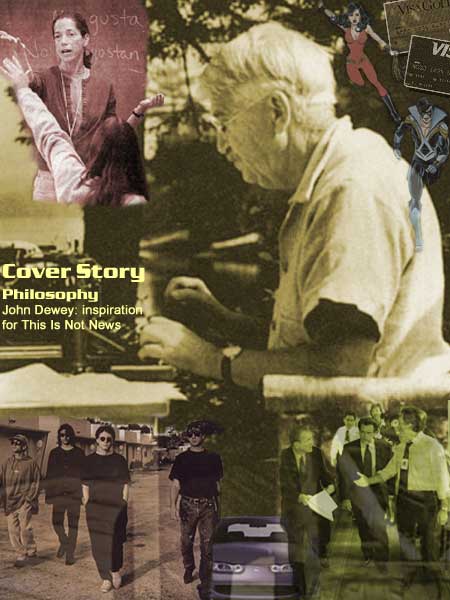
One of the things Pattie and I had done in the weeks before the con was to go over the programming list to select all the entertaining and informative panels that we would attend. Unfortunately, these well laid plans were shot to pieces pretty quickly, especially for me on Sunday. George Perez, one of my favorite artists (whose work appears in the corner of the first Not News cover image, by the way), was at the con and doing free sketches for his fans. Unfortunately for me, George Perez has had a spectacular 25+ year career in comics, and he’s a LOT of people’s favorite artist. So much so, that somehow the lines for his sketches managed to be full practically before the convention opened for business each day. (I am still trying to figure out how that worked, by the way. The ability to distort time and space in that fashion would pay off my student loans in a hurry.) In true comic fashion, I got my sketch in the nick of time, with about 15 minutes before the whole con closed, and after a four hour wait that absorbed most of the day. Now you can say that’s crazy, but hey — someday, I might find myself stuck in a six hour line at DisneyNation and look back fondly on the old days.

The Juror Is Out

I had the following dialogue at least a dozen times in the beginning of July:

ME: I have to go downtown for jury selection on the tenth.

OTHER PERSON: Oh, they’ll never pick you. Lawyers never pick jurors with too much education.

I’ll be honest, I assumed the same thing, and I guess I can’t blame anyone who would knock a philosophy PhD student off a panel. I mean, would you want to have to convince some know-it-all punk whose job it is to nitpick and find holes in any argument? And while it bugged the nobler side of my nature, which really wanted a chance to do its civic duty, there was a side of me that really hoped the conventional wisdom would hold up. I had just finished teaching an intensive summer course at Temple, I still had a month to go in the other course I was teaching, I had a number of personal and academic projects to catch up on (including this site), and Pattie’s and my vacation in San Diego was fast approaching. So somewhat smugly, I showed up at Philadelphia’s Criminal Justice Center and figured I’d collect my nine bucks and be on my way.

Whoops. I must have been really convincing during the voir dire stage, because despite my education, despite my having been mugged last November, and despite having had some relatives who’ve had run-ins with the law, I found out I was accepted for the jury, and that I would start hearing a rape case on Thursday, two days later. All of a sudden, I had to make plans to cover the two class sessions I was guaranteed to miss, to say nothing of the fact that my plane left for San Diego exactly one week after the trial was set to start. The judge had said she expected the trial to take until Tuesday, which left only a one day margin for error.

Now, like I said, I was a little annoyed by this, but the larger part of me was excited about the chance to use my reasoning skills to serve the community. And when I arrived at the courthouse the first day, I quickly realized that my fellow jurors were intelligent, serious-minded people who took the responsibility seriously, as irritated as they may have been to have their lives disrupted by it. I was feeling pretty optimistic about our chances to resolve the case fairly, intelligently, and within the expected time frame. Then the trial started.

I may be biased by this experience, but I can not think of a harder type of case to decide than a rape case like this one, where both parties acknowledge sex took place and the crucial issue is whether or not there was consent. It’s not a question of looking at facts and determining if those facts are valid evidence for a particular conclusion, like ‘Is so-and-so’s alibi valid’ or ‘did so-and-so really have the opportunity to commit the crime.’. Ultimately, it boils down to a she-said/he-said (or a she-said/his-lawyers-said) situation, where your decision ultimately rests on your assessment of the alleged victim’s credibility. And that means that the ideal defense strategy is an all out effort to destroy that credibility, in a scene right out of every rape-related movie of the week. The defense made every effort to imply that the alleged victim had been flirting with the defendant for weeks, that she had behaved suggestively the entire night of the incident, that she had invited the defendant to her room and that the allegation of rape was a hastily-concocted attempt to save her reputation with her friends and boyfriend. It was a classic blame-the-victim maneuver, delivered by a female defense attorney whose smugness and hostility made me want to get out of the jury box and slap her. At the very least, I wanted to deliver a guilty verdict to show her that This Would Not Be Tolerated.

There was only one problem. Remember what I said about the case boiling down to an assessment of the alleged victim’s credibility? Well, I had major problems there. Her testimony conflicted in major ways with just about every other witness’ account of events before and after the incident. Now, my study of history and of journalism has shown me that there are almost always inconsistencies in different accounts of events — heck, when my friend and I were mugged, we remembered different things and different parts of the event only a few hours later. But in this case, the inconsistencies were major, and concerned crucial elements of the alleged victim’s testimony, details that were so significant it’s hard to imagine how one might forget or confuse them. The only conclusion I could come to was that the witness was lying about certain things.

Now, the judge’s instructions to the jury are quite clear — a juror can believe all of a witness’ testimony, or part of it. It’s not required to assume that because a witness lied in one instance, he or she was always lying. And it was plausible to me that the alleged victim was telling the truth about the alleged crime and lying about other significant elements in a misguided attempt to make her testimony more believable; in fact, that’s what I considered the most likely explanation. But then there’s the other part of the judge’s instructions — the definition of ‘reasonable doubt.’ We throw this phrase around all the time — Lord knows I use it often in my logic and critical thinking classes — but I don’t know if I had ever heard the official definition. A ‘reasonable doubt’ is one that would cause a person to pause or hesitate before making an important decision. Well, judging by the tossing and turning I was going in bed thinking about this case (and let no one tell you that jury duty is a walk in the park; besides the effort required to listen to and retain testimony — since you can’t take notes or reread the transcripts — the sheer weight of the responsibility is draining beyond belief), how could I not say I had reason to pause or hesitate? Sure, I had concluded that it was most plausible to believe that the alleged victim was lying about some things but truthful about other things, but the idea that she was lying about the whole thing was plausible, if unlikely. Thing is, I wasn’t allowed to say that the defendant was probably guilty. The presumption of innocence means that it had to be all or nothing. And I fully support that standard, even if it means that sometimes juries will have to let a person they believe probably committed a crime go free.

However, for a small but significant minority of jurors, there was no doubt in their mind that the defendant was guilty. The scenarios that I found to be plausible enough to raise reasonable doubt weren’t at all convincing to them. And there was no convincing these people otherwise — they had the courage of their convictions, and I applaud them for that. The notion of some kind of compromise verdict that would let us all get back to our lives was raised, and quickly dismissed. Moments like that made it a trying but ultimately heartening experience. The only problem is that our deadlock meant that the jury deliberations took far longer than anyone expected — and it came time for me to fly to San Diego. The other jurors were escorted out of the courtroom while I was left alone with the judge, who thanked me for my effort and dismissed me from the panel. I was free, but I felt an overwhelming sense of disappointment and failure that I have not been able to shake. I so desperately wanted to finish what I started, to resolve the question before us one way or another. Instead, I was being told that life, and the deliberations, would go on without me. I’m trying, now, to retain the positives of the experience; my faith in the possibility of a citizen democracy is restored, and my belief in the importance of the Not News project is stronger than ever.

Most of What Follows Is True

One of my graduate courses last spring was a seminar in what’s currently called “public history,” which pretty much covers any historically-grounded work that’s produced by and/or intended for an audience consisting of people outside the academic historical community. Museums, monuments, and commemorative memorabilia all fall into this category; so do many forms of historically-derived entertainment, from docudramas and documentary programs like Biography, Behind the Music, or Ken Burns’ documentary films to memoirs and biographies to films and programs that claim to be ‘based on a true story.’ It’s a very wide and varied field, and while the labeling of it as ‘public history’ is something of an attempt to maintain the perceived purity of the academic discipline, it’s also a recognition that these works are more accessible to the public than many of the texts and articles that attract the attention of ‘professional’ scholars. One of the challenging questions we grappled with throughout the term was how far one can go in trying to attract the public to a historical work while still maintaining the work’s integrity. This was very clear on the first night of the seminar, as we discussed what an ‘ideal’ public history project would look like, and whether any of the historically-inspired blockbuster motion pictures had a place in serious public history.

I was seriously torn on the issue. We’ve discussed the presence of cultural myths several times on the forums; I believe that these distorted views of our own history are one of the most serious problems we face in society, because they form the bedrock of many people’s resistance to the social changes needed to address our problems. (The myth of rugged individualism, for example, is one of the reasons why reforming our school funding systems is such a challenge.) Any form of popular entertainment that perpetuates these myths — such as the historical exhibits at the Disney theme parks described in Mickey Mouse History — has something to answer for, in my opinion. I think shows like Behind the Music and Biography can be dangerous in the way they transform history into entertainment by playing up certain emotional themes and restructuring a person’s life into a relatively brief narrative; the fact that many of these programs occur with the cooperation of their subjects is another cause for skepticism.

Furthermore, I am worried that many people will see that a film is based on true events and assume — consciously or unconsciously — that what they see on the screen is what “really happened.” I love Apollo 13, for example, but the filmmakers apparently chose to play up the tension between Bill Paxon’s and Kevin Bacon’s character in a way that did not really reflect what happened during the mission. Oskar Schindler’s breakdown at the end of Schindler’s List was also a Hollywood creation, and the writers chose to create composite characters for the sake of the storyline. Dramatically, I think the former worked much better than the latter. But both films are compromised as historical works. Continue reading “Most of What Follows Is True”

The Solo Musician’s Guide to Playing with Oneself

Technology is an amazing thing. These days, all you need is a computer a few select software packages to make yourself sound like a professional musician. Often enough, these music-building applications are really built on samples and riffs played by actual professional musicians, and while it’s fun to muck about with that sort of thing, samples and an editing program do not a professional musician make.

However, I do have a romantic fascination with the concept of one person, in a studio, playing every instrument and singing every part of harmony without a backing band or other vocalists. It could be my own shyness at work, but I’ve always thought that’d be a very cool thing to do. I have a low-end consumer-grade home studio myself, and I do quite a bit of instrumental work myself along those lines. I’m not going to try harmonizing with my own vocals until the UN lifts that pesky Geneva Convention ban on my singing, though. They seem to think that my voice will do harm to nearby property and livestock. Really, those 1500 dead cows must have heard something else.

In the meantime, I can enjoy the works of others who have gone this route. I’ve chosen to focus on four favorites from my own library, so the usual disclaimers apply – these artists naturally fall within my own parameters of musical taste and as such, your aural mileage may vary. Continue reading “The Solo Musician’s Guide to Playing with Oneself”

Can’t Get There From Here

Thirty-two years ago, on July 20, 1969, human beings set foot on the moon for the first time.

Today, we couldn’t go back if we wanted to.

More than anything else, that sums up the current state of spaceflight research in the United States. The US stopped building the Saturn rockets that sent the Apollo missions beyond the orbit of the Earth years ago, and never developed a successor. We cannot go to the moon. We cannot go to Mars. We cannot go any farther than the low-Earth orbit of International Space Station Alpha and the space shuttle travel. What is worse, we have no plans to go any farther, no idea of how to get there from here. NASA is still trying to decide what kind of orbital craft will succeed the space shuttle, despite the fact the current fleet of orbiters is much closer to the end of its life than the beginning. There are currently no plans to use Alpha to construct interplanetary craft. There is no vision for the future, and thus no effort to make that vision real. Continue reading “Can’t Get There From Here”

Let the Light In

Have you read Not News’ privacy policy yet? I hope you have, because a) Pattie put a lot of work into it and b) I want you to understand that I take respecting people’s rights, including privacy rights, seriously. That said, there seems to me to be a good chance that we’ve been tackling this privacy issue all wrong, or at least that we haven’t been as robust in our thinking as we could be. Right now much of the privacy debate focuses on standards of encryption and laws that forbid people who have certain information from using that information in certain ways. (Check out sites like the Electronic Frontier Foundation for more info.) The argument is that everyone should have access to the technological tools that can keep other people from knowing what they’re doing, that anonymity and secrecy are vital to the protection of a free society. But maybe, and paradoxically, an effective solution can be found by making it easier for us to get information about each other.

We’ve gone over this topic before, in our message forums. It was there that I first brought up David Brin’s The Transparent Society, which I’d like to discuss in a little more depth here in the essays section of the site. Brin, an astrophysicist/SF author/commentator, argues that encryption/secrecy proponents are actually working against the interests of a free society, which requires that information flow as freely as possible in as many directions as possible. In a society such as ours, in which so much power is concentrated in the hands of corporate and government entities, the emphasis on secrecy works in favor of the powerful. Not only do they have more to potentially lose if many of their doings become public, but they have a greater ability to amass the technology necessary to effective gather and process information, and avoid or minimize the penalties for misusing that information. Think of how Microsoft has managed to thus far mitigate the damage from its unfair business practices. Or of how the control of surveillance and observation cameras seems to rest in one set of hands.

Transparency, or information flow, on the other hand, works to the benefit of everyone in society. One of the reasons the American financial markets are so popular with global investors is that for all its faults, our Securities and Exchange Commission requires American companies to disclose far more details of their operation, in a timely and accessible manner, than just about any other country. There are accounting scandals and problems in America, to be sure, but they are minimized because anyone can head over to a site like FreeEDGAR and peruse a company’s recent 10-K report. As long as privacy is the weapon of choice, large entities with more to hide will always do a better job of hiding it. But if everyone knows everyone else’s business, then we can rely on each other to watch out for each other. One reason why people do things that work against society’s interests is that they believe there is little chance they will be discovered. Transparency works against that, and helps keep people on their best behavior.

The most frequent complaint against Brin’s thesis is that while transparency may be all well and good, there are certain things that people don’t want other people to know, and that the ability to see what someone else is doing is not a sufficient tradeoff for someone to see what they’re doing. Brin takes this into account by saying that certain zones of privacy would be necessary; he’s not offering a black-and-white, all-or-nothing solution. A transparent society would, he claims, again paradoxically, protect privacy by making it easier to spot those who would violate the bounds of common courtesy, rather than leaving the tools of privacy-invasion in the hands of a privileged few. But I would also like to examine the emphasis on privacy and anonymity that exists in American culture, particularly on the net. Andrew Leonard’s Bots discusses net culture (or at least net culture circa the mid-to-late 90s, when the book was written) and finds example of example of individuals using the net’s cloak of anonymity to commit antisocial behavior, disrupting discussion forums and chat rooms, crashing sites, and so on. Message board protocols often suggest that you shouldn’t post anything you wouldn’t be willing to say to someone face to face, where you would be accountable for your words. Maybe a little transparency wouldn’t be such a bad thing there.

But what about people who aren’t committing antisocial acts but still want anonymity or privacy because of an unfair social climate that might stigmatize them? What about an adolescent who’s trying to deal with the possibility that he or she might be a homosexual, or an individual who might have a socially-unacceptable disease like HIV? Here I’m not so sure. I agree with Brin’s notion of privacy zones for things like this, but I know that in some instances those will be breached. Am I willing to see that happen? I don’t know. Part of me thinks that a lot of stuff would become less socially unacceptable if we all knew how common it was, or at least how many people all had some kind of ‘guilty pleasure’ — if we all had to accept each other’s quirks in order to be sure that our own quirks were accepted, wouldn’t that contribute to a more robust society in the long run? I can’t help but think that it would . . . which leads me to believe that the growing pains of getting to such a place, while uncomfortable and unfortunate, would be worthwhile. We may not quite be totally ready for transparency yet — we may have a generation or two of greater tolerance and open-mindedness to teach before we get there — but I can’t help but think of it as a worthy goal.

Young Guns for Great Comics

If Larry Young’s only contribution to comics were the Astronauts in Trouble series, he’d be a darned important figure in American comics. Not only does this SF series combine great fun and action with nifty characterization, Young’s decision to publish AiT in the form of original graphic novels (OGNs) rather than single-issue mini-series is a reminder that comics shouldn’t be limited to a single format. But Young is much more than the writer of AiT and the upcoming Planet of the Capes — he runs AiT/Planet Lar, a company that publishes OGNs and trade paperback collections (TPBs) in a number of genres, including the terrific Channel Zero by Brian Wood. He’s a relentless “comics evangelist,” writer of the completed TRUE FACTS series on self-publishing in Savant magazine and the ongoing LOOSE CANNON column at Comic Book Resources. He’s a frequent poster at a number of comics message boards, including his own Delphi Forum and the Warren Ellis Forum. Flat out, he’s one of the smartest guys in comics, a guy who knows what he wants and is willing to put in the work to get it.

As the name “Astronauts in Trouble” implies, Young is also a space fan of the highest order; indeed, he has been known to argue that there is no film or story that can’t be made better by sticking in a guy in a spacesuit.

“Astronauts are modern-day knights-in-shining-armor,” he says. “Putting on their specialized suits to go into such an unforgiving environment . . . I mean, if a reader doesn’t see the inherent romance in space exploration, I can’t help them.”

The first AiT story is Live from the Moon, a real treat for fans of realistic science fiction. It’s the story of the news team that is selected to accompany Ishmael Hayes, North America’s leading businessman, on a self-financed voyage back to the lunar surface to commemorate the fiftieth anniversary of the Armstrong landing. Since the real moon landing was such a pivotal event in Young’s fascination with space, it seems only natural that it would be the subject of his first space story.

“I lived in Dallas, Texas, just down the road from Houston when I was six years old, in 1969,” he says. “When Neil and Buzz first landed on the moon and said, ‘Houston, Tranquility Base here; the Eagle has landed’ they weren’t just making one small step, they were walking around on the moon and talking to ME.

“I think the concatenation of effect of being an impressionable lad with a great imagination, doting parents who made sure I had a telescope to look up at the moon during the Apollo 11 mission, and the geographic nearness to Mission Control scarred me for life.”

As I mention in my review of Live from the Moon, Young doesn’t scrimp on characterization despite the abundance of space action, especially in the interactions between anchor Dave Archer, cameraman Heck, and segment producer Annie.

“I needed an audience in to the story, and it made sense that it’d be the on-air talent. In order to short-hand to the reader that Channel Seven is the premier media outlet of the story, I had our other characters archly refer to Dave as the ‘Most Trusted Man in North America.’ He’s the Walter Cronkite of his day… but he’s a shell… a suit… a goofball. If his audience knew him as Heck and Annie do… they might not be watching Channel Seven…

“I was thinking of the famous triads in literature and in Pop Culture who represent two opposing viewpoints around the guy in the middle. What Leonard Nimoy famously described as ‘The Soliloquy Structure:’ that in Star Trek, if you took Hamlet’s soliloquy and made it Star Trek dialogue, you’d have Mr. Spock saying, ‘To be,’ Doctor McCoy would say, ‘Or NOT to be,’ with Captain Kirk in the middle saying, ‘. . . that is the question.’

“So I made Dave the central figure between the no-nonsense segment producer and the wise-cracking cameraman. If you have three main characters spanning that spectrum of reaction, the story almost writes itself.”

AiT/Planet Lar publishes a lot more than Astronauts in Trouble books, however. Young has put his muscle behind a number of independent creators to establish a line of OGNs and TPBs with a high reputation for quality. The amazingly-well-designed Channel Zero is probably the best-known of these at the moment — if you haven’t read my review of it, please do, and check out Brian Wood’s website while you’re at it. Channel Zero is the story of a near-future where the US, especially New York, have been overrun by censorship, and it stretches the existing boundaries of the comic format by incorporating a number of slogans and visuals into the pages that may be distinct from the main narrative but reinforce the message and feeling of the book.

Wood has also designed a number of covers for AiT publications, helping to craft and display AiT/Planet Lar’s identity as a forward-thinking comics publisher.

“I just like Brian Wood’s design sense,” says Young. “He’s done five of our eleven books, and it’s really quite neat to have that singular vision of an extremely strong artist and designer. He’s my guy I ask first, that’s for sure. If someone else does the book design, it’s because he doesn’t have time that month in his schedule.”

It should come as no surprise, then, that Wood and Channel Zero are something of the centerpiece of the publisher’s list of upcoming projects; over the next nine months AiT will release a Channel Zero follow-up, a prequel of storts, and a design book. Next up, in October, is CousCous Express — a story about a turf war between rival New York restaurants that includes some characters from the first book.

But wait, there’s more. Transmetropolitan author Warren Ellis has two projects on tap, a military space adventure called Switchblade Honey and Available Light, a collection of short stories and photographs all written on or taken with a Handspring Visor; AiT has already published a collected edition of Ellis’ COME IN ALONE essays. Young himself will tackle the superhero genre with Planet of the Capes, and several other noted creators will release new TPBs or OGNs — the full lineup is available from the AiT website. It all fits into Young’s vision for the company.

“We publish books that I characterize as science fiction and ‘action-adventure-with-a-twist’ by quality creators on top of their games. When people see a logo that says, ‘An AiT/Planet Lar publication,’ I want them to associate that with a high quality graphic novel or trade paperback.”

He’s off to a great start.
The Peanut Gallery Strikes Back

In case you haven’t noticed, the “c” word is pretty big around here. No, not “cheesesteak,” though that may run a close second. I’m talking about “community.” In fact, in some from or another, we at TINN are always talking about community. It’s why we’re here; it’s why this site exists. There are literally thousands of small online communities in existence consisting of groups of people bound together by commonalties others would find strange. In studying even one of these groups, you might be surprised to find how they define “community.” I was the first time I entered a fan fiction community.

To use the widely accepted definition, fan fiction is the reworking of the original text of a motion picture, television program, novel, or series of novels to better serve the needs or interests of a smaller community. That definition is not mine; it comes from researcher Henry Jenkins who literally tagged along with Star Trek fans for years analyzing their interactions at conventions, meetings, etc. Jenkins also came up with some general fan fiction categories, which do a great job of furthering explain what fic writers do with their source material. Here, briefly are the basics: Continue reading “The Peanut Gallery Strikes Back”

You Are Not Helping, Boss

Even those of us with less than 10 years working experience can recognize bad management skills when they see them. Between my jobs in college, my semester internships and my post-college employment roller coaster rides, I could probably pick poor management skills out of a line-up at three in the morning. So in honor of the first month in my MBA program and just because I feel like it, I’m writing an open letter to my bosses letting them know that the dumb things they did have not gone unnoticed. My collection of past and present supervisors will be consolidated under one false name for space and privacy purposes. (Not that I really need to worry that any of them are wasting time reading this. Most of them have a very busy puppy-kicking schedule to keep.)

TO: Maurice Ron
FROM: Me
RE: The Sense God Gave You, Lack Thereof

Good advice is something one seldom asks for but always needs. Please take my advice for what it is worth and remember that constructive criticism builds a better you.

  • The management course you took that advised keeping ill-informed, angry, inept workers on your front lines (e.g. in customer service, on your sales force) was not seeing the whole picture. I would seriously consider rethinking this tactic.
  • Do not implement an expensive and complicated software system before at least two people in your company understand it. Also, for the love of all that is good and decent, don’t take the older system off-line before you have a plan in place to fix the new one when (and I do mean when) it breaks.
  • Please do not change the security code on the restrooms without telling anyone. It’s really not funny after the first two times.
  • Proving Darwin’s survival theory with free pizza is not everyone’s idea of a good team building strategy. We truly do not like having to outwit, outsmart, or outplay our colleagues for food. In short, when ordering lunch for the office, do be sure to order enough for everyone.
  • Do not refer to female employees over the age of 18 as “your girls” no matter how much you may think you look like Cary Grant.
  • If you monitor your employees’ Internet use, do so wisely. The occasional Steven Wright-isms email is not cause for a memo. On the other hand, a 75% increase in traffic to Monster.com may be worth looking into.
  • For the last time, learn the difference between “Reply” and “Reply to All.” It’s much easier than trying to explain how you meant “damn pain in the ass” in a good way. The corollary to this advice is to remember to hang up the phone completely before calling the person you were talking to a bastard.
  • Do not assume that one over-performing department can make up for five under-performing departments. No, not even if they work Saturdays.
  • The karaoke machine you rented for the office Christmas party did not make up for the lack of bonuses that year. It really didn’t.
  • Your “whoever buys my lunch gets to be favorite employee of the day” routine wears thin really fast.
  • Publicly berating people for their work performance does not make them better workers, it just makes them pissed at you and they often quit. You end up with empty positions and unfinished work. So when you think about it, your legendary tirades serve only as complete wastes of time.

Sincerely,

Your employee

Author’s Note: While I have exaggerated a bit for comic effect, most of the situations on which these comments based actually happened. I’ll be more than happy to explain on the boards if you’re really interested. I’d much rather read your additions to this list, though.