He Did It All for the Nyuki – Part 2

KO: How old is your son?

JH: My son is two right now. But I wrote Clan Apis when I was just married and planning to have kids, so I guess I always thought in those terms. I guess — this is going to sound screwy — but as far as things like that are concerned, I’ve had my son in mind, and I’ve had my mother in mind. My mother and my father. I want to write stories that they can read.

KO: What kind of readers are your mother and father?

JH: Well, I guess it’s not in terms of necessarily the content. But I come from northern Indiana, a small midwestern town, but a lot of cursing, and sexual situations, and a lot of gratuitous, drippy, bloody violence — not that that’s my voice anyway — that’s not something I’m gonna hand to my mother, or that I want my son to read. And I can’t say for certain whether or not that’s the voice inherent in me, or whether it’s a voice that’s a reaction to a dearth of that type of material. In any event, that’s just the way I write. Because a Warner Brothers cartoon was the same way. As nasty as it got was Bugs Bunny wearing a bra.

KO: And I can enjoy them just as much now as I did when I was six.

JH: And that’s, to me, the key. It’s writing a story that I can enjoy and be proud of now, and in twenty years. That can sit on a library shelf and not be dated. The word my wife constantly accuses me of using is “classic.” There’s something that isn’t rooted in a particular time, and is accessible to anybody who wants to read it at any time. Because the minute you start doing those other things, I think you start cutting yourself off from people. It’s my desire not to cut people out. And the reason that’s important is that it comes from a second perspective from which I write, and that is as an educator. I want to teach people something. So much of the stuff that I pick up — and this is true of comics, it’s true of books, it’s true of magazines — I find myself growing very frustrated, because I read these things, and I don’t walk away with anything. My life hasn’t been enriched in any way. Now that’s not true of everything, but I think a lot of stuff out there just sort of, you know, exists, kind of goes through the motions of telling a story. It doesn’t really do anything to improve me. You know? I don’t want to cut myself off from an audience. The minute you do that, the minute you turn off potential students is the minute you fail to educate somebody, and that’s no good.

KO: You mentioned gratuitous blood and gore — do you think there’s an excess of that in comics specifically? It sounds like maybe you do.

JH: Well, to say there’s an excess is to suggest that I’ve studied the situation, and I have not. So all I can go on is anecdotal stuff. Comics are like movies, so it’s not as if it’s something that’s unique to comics. Comics are like movies — you see more now, there’s a lot less left to your imagination. And growing up, I was never a kid who liked gory movies. I liked scary movies. To this day, I still enjoy watching The Creature from the Black Lagoon, those classic Universal monster pictures. They still scare me a little bit. But I never enjoyed the Halloween, the Friday the 13ths, the hacking and chopping, that just wasn’t my style. So when I see it creeping in, and you can see people holding decapitated heads dripping on the covers of comic books. And it’s not that I think, “oh my goodness, we should censor that,” And I can’t even say that it shouldn’t be done, but invariably it’s going to affect public opinion. And people can make the argument that movies are the same way, people don’t castigate movies because of violence, but the bottom line is, movies are doing fine. There’s no fear that the movie industry is going to collapse. And so that may be true, and people are free to make whatever comics they want, because as long as there’s a market for them — and that’s the other thing. They’ll only be produced if there are people buying them. And you don’t publish books like that at a loss. And so there’s clearly a market for them, so I’m not making any sort of judgment call on them, but it would be nice to see, and I think there are — okay, so now I’ve just sort of spiraled right into mishmash, but — my gut is, when I look at the stands, that it’s a more violent place than it used to be. It’s a less noble place than it used to be, in all genres. I prefer to contribute to something that attempts to be much less violent and more hopeful.

KO: And Clan Apis is nothing if not hopeful.

JH: I hope so.

KO: Staying on that track, you’re very frank about death in Clan Apis, and its place in the cycle of life and in the universe as a whole. When you were thinking that you were going to be writing for all ages, was there ever a contrast as far as writing something for all ages yet not pulling any punches?

JH: It kind of goes back to kids being smart, and kids being able to handle things. My dad, when he was growing up, he was orphaned when he was very young. And it’s a corny story told by my father who grew up in the 40s, but he went to see “Bambi” with his aunt, within the year. And he still talks about how Bambit’s dad says, “You gotta go on. You’ve got to pull yourself up by your bootstraps, and that’s just the way it is.” And now people criticize that because, you know, we can’t show kids death, and blah blah blah, and it’s a violent image, but the bottom line is that kids have to potentially deal with death in some respect all through their life. I think they’re capable of dealing with a lot more than we give them credit for. We’re not talking about the death of their aunt or uncle here, or a relative. We’re talking about the death of an animal. And I think the understanding that that’s an element of an animal’s life is an important thing for them not to ignore. Because you can Disneyfy nature too much, you can make it a little too warm, a little too cuddly, and that goes back to the dangerous spiral of anthropomorphizing. These bees are my characters. These bees are my heroes. The queen I liked, Queen Hatchi. But you find out she had to kill the previous queen, and so these elements are not things — as long as you don’t have eviscerated bees lying around and stuff, then these are things that kids can deal with. The real motivation for dealing with that properly on a more important level was my own — if this came through as a fundamental part of the story, it’s because I’ve always dealt with an awful fear of death. And so Nyuki was my surrogate for a lot of things in the story. Like my fear of change, and fear of death as the biggest change there is. And this was sort of my way of dealing with that issue, and in some respects I view that as one of the more grown-up elements, and one of the things that a kid will probably just gloss over. I’m not sure I dealt with the metaphysics of that very well.

Winds of Change, or More Hot Air?

“When in human history has positive change not been incredibly costly, selfless and bloody?”

Christian Gossett asked that question in an interview on this site, almost a year ago, and it’s been at the back of my mind ever since. Not News is dedicated to the idea that people can come together, talk through problems, look at evidence in a critical fashion, and come to an agreement on what should be done for the good of everyone. We sit at computers, surf the web for research, make some phone calls and post on the forums. Doesn’t sound very costly or bloody . . . or even all that selfless. The thought has entered my mind, more than once, that maybe all we’re really doing is salving some guilty consciences.

That thought hit especially hard as I read William H. Chafe’s Civilities and Civil Rights, an excellent book that tracks the progress — and lack thereof — of the civil rights movement in Greensboro, NC from the mid-50s through the 70s. Drawing on extensive interviews and written archival materials, the book is a tightly focused narrative that goes into great depth as it covers the community leaders and members that can get missed in larger overviews of the civil rights movement.

What is most fascinating, and most troubling, about the book is the vast disconnect it portrays between Greensboro’s image of itself and its reality. Greensboro had long considered itself a ‘progressive’ Southern city, with a more modern outlook and economy than many cities in the Deep South — and certainly with better, and fairer, relations between the city’s white and black populations. There was a black member of the city council in 1951, and also a black member of the school board. Several of the city’s philanthropists contributed significant sums to facilities in black neighborhoods, and a few major institutions were willing to work toward integration. And city leaders were almost always willing to discuss race relations in civil discourse, through official committees and informal talks.

The key word, there, is ‘civil.’ The powers that be did not want to ruffle any feathers, they did not want to provoke controversy, and they certainly did not want to suggest that conditions in Greensboro might be less than ideal. Change in Greensboro was expected to be attained through consensus, which meant that if anyone objected to change, then the status quo would be maintained in the name of civility, until the objector could be persuaded to change his mind. And rest assured, if a change would require that whites give up some of their entrenched power or privileged space in society, there would be objectors.

Greensboro was the birthplace of the student sit-in movement in February 1960, when four students and North Caroline Agricultural & Technical College grew frustrated with the slow pace of reform — lunch counters were still segregated, many jobs were off limits to blacks, and six years after Brown vs. Board of Education, black children still weren’t attending white schools. The students went to a downtown Woolworth’s, made purchases, and then st down at the lunch counter. When they were refused service, they stayed. Within days, dozens and then hundreds of students — and eventually adults — joined in the effort and brought commerce in downtown Greensboro to a standstill.

Here’s the interesting part. The powers that be of Greensboro did not respond to the students with a statement of, ‘Thank you for bringing this blatant hypocrisy and act of disrespect to our attention; we will remedy it immediately, and please accept our apologies.’ They criticized the protestors for being disruptive, threatened to enforce anti-trespass laws, and refused to believe that the protestors reflected the will of Greensboro’s black population. “It seems apparent,” said North Caroline Attorney General Malcolm Seawell, that these incidents have been promoted, encouraged, and even supervised by persons coming into North Carolina from other states” (Chafe 86).

Some white liberals did attempt to use the demonstrations as a catalyst for social change, as did a very small number of city leaders. But even those efforts showed the limits of a consensus-driven approach — a group of community leaders came together to negotiate first a moratorium on demonstrations and then an overall solution. They got the moratorium, but with the pressure off, and with the negotiating group having no official power to sanction anyone, businesses retrenched. The community leaders operated under the assumption that it was necessary to build up something close to unanimous public support for integration before anything could change. Meanwhile, the local Woolworth’s manager wrote to the governor, “We are fighting a battle for the white people who still want to eat with white people” (Chafe 93) — which pretty much sums up the chances for such a consensus. Fed up with the lack of progress, the students resumed the demonstrations, and eventually the lunch counters were integrated. But change only occurred when the oppressed made life uncomfortable for the oppressors, many of whom refused to believe they were doing anything wrong.

The civil rights movement is full of such stories. Local residents showing great courage and determination called attention to injustice, and when they tried to play within the existing system, they found their needs sacrificed in the name of political expediency. In 1964, for example, a group of Mississippi activists challenged the credentials of Mississippi’s delegation to the Democratic National Convention, on the grounds that black voters had been disfranchised — but President Johnson was unwilling to anger Southern Democrats by letting a vote on the credentials challenge go to the convention floor (where it almost certainly would have won). And when civil rights leaders began to call attention to the racial inequities of the American economic system, many of their political allies turned a deaf ear. Clearly, there are limits to working within the system, and you could make a strong case that a reform movement that relies on politely asking the system to change its ways is no reform movement at all.

So what are we left with? Is the only honest, and honorable, solution a remorseless, revolutionary struggle (to steal a phrase from Abraham Lincoln)? I’m not sure that’s the answer either — such a struggle is bound to cause resentments, and even if a revolution somehow put a just system into place, the overthrown would be more likely to nurse their grievances rather than become a part of the new society. There’s another Gossett quote that comes to mind: “No war has ever ended that did not begin another.”

The only truly lasting change will come when we change our hearts and our minds, and I don’t think that change can come at the end of a gun. It can only come slowly, and it will take a critical mass of everyday people who are willing to recognize that it is necessary. It will take people with the tools to analyze the world around them, to see where and how it could be better. One of the inspiring elements of Chafe’s book is the four students’ recollections of the role models that gave them the courage to take a stand — the teachers and leaders of their community, the people who did work within the system but weren’t afraid to tweak it where they could. When I think of what Not News can be, that’s what I like to imagine. We will always need heroes to stand up and shout, to call our intention to injustice. And it may be getting time to shout a little louder. But we also need people to talk to each other — and that’s why we’re here.

He Did It All for the Nyuki

Quick. Name an Eisner-award nominated comic artist and writer who also has a Ph.D in biology and teaches college-level science classes. The answer is easy, mostly because there aren’t many people in the industry that fit anything even remotely resembling that description (It’s hard to imagine Garth Ennis giving a lecture on mitochondria).

Somehow, Jay Hosler has found the time to devote his life to both the study of life sciences and the production of great sequential art. His current big seller, Clan Apis, tells the story of Nyuki, a honeybee who takes herself — and us — on a journey through life in the hive and as part of the swarm. The six-chapter collection was nominated for two Eisners this year.

Widely discussed as a work accessible to — but not written specifically for — children, Apis is lighthearted but pulls no punches in its description of life as a bee. Its frank description of death and conflict in a world populated by wisecracking insects provides a welcome sense of balance in a medium where stories for all ages aren’t easy to come by.

Meanwhile, the first issue of The Sandwalk Adventures, Hosler’s newest work, hits shelves in December. The series chronicles conversations between Charles Darwin and a microscopic mite living in the follicles of his eyebrows.

Again, not something you’re likely to see from Garth Ennis.

Hosler lives in central Pennsylvania with his wife Lisa and son Max, who enjoys playing with mechanical pencils. Jay and Lisa are expecting a second child soon.

KO: Le’s talk about Clan Apis, since that’s kind of your opus right now. I think it’s fair to say that it’s written for younger audiences, or at least written to be fairly accessible to younger audiences.

JH: I think the latter is more what I had in mind. It sort of goes to the real concept of “all ages,” which means that it should appeal to, well, all ages. Unfortunately, it’s sort of in a market right now where “all ages” is translated as “just for kids.” And so, and I’ve said this before, I think, to people, that I sort of write these things like I imagine the old Warner Brothers cartoons, which was, you know, there’s slapstick and silly stuff for kids, but there’s another level, that kids will just skip over things they don’t get, as long as you give them enough material to keep going. And then there’s political commentary and broader thoughts that should appeal to older readers.

KO: How did you feel, then, when the Eisner nominations came through, and they addressed your work in terms of its youth orientation?

JH: Oh yeah, I have no problem with that, because ultimately, if I had to pick a market that is completely, in my opinion, unaddressed in the comics medium today, it’s kids. I mean, what book are there out there for kids? You go into comic shops now and you’ve got Akiko, and you’ve got Bone, and you’ve got Castle Waiting, which are all great books — Amy Unbounded, which is a mini-comic, is a great book — but in reality, compared to the vast content of Previews — this is not a slamming of Previews, this is a comment on the type of material they receive — is almost exclusively adult-oriented. And so to be nominated in a category for kids books, I have no problem with that. I’m excited about it.

KO: I’s interesting you’re saying this, since people outside the medium generally stick to the belief that comics themselves are pretty much just for kids.

JH: Yeah, it’s an interesting dichotomy. It is considered sort of childish literature. And I think there’s been a real concerted effort by a lot of people to make it adult, and when I say adult here, I mean what the real world means — not, like, pornographic. Something that a grown-up could read and not feel embarrassed about. And of course there are tons of books out there like that. One of my favorite books of all time is Minimum Wage. It’s not a kids’ book, but it’s not standard everyday fare either. The problem is that it almost seems like this desire to legitimize ourselves as okay for adults to read has left this dearth of material for kids to read. Companies make attempts at kids’ books, but usually that fails, because most people have no respect for kids’ intelligence.

KO: What are you thinking of specifically when you say that?

JH: I’m loath to single things out, but I’ve seen books come out from various publishers within the last two years that, in my opinion, missed the mark on what kids want, because what you’re doing is you’re thinking of it in terms of what kids want instead of just writing a book that could be read by a kid. I know that’s sort of a fuzzy distinction. I think that when you sit down and think, “I’m going to write something that a kid would like,” you’ve already started from the wrong standpoint. For example, I don’t think Linda Medley sits down with a Castle Waiting story and says, “I think a kid will like this.” I think she sits down and writes a story and does certain things, like — this is going to make me sound like an old fuddy-duddy — but you don’t have cursing in it. You don’t have gratuitous sexual content. You don’t have gratuitous violence. She tells a story without those trappings, so in that respect it’s accessible to a child, a child can pick it up and read it. Now, there are also elements to it that a seven-year-old kid won’t get. But at least there aren’t those really strange barriers to a kid reading it. I guess I’m not in Linda Medley’s mind, so I don’t know what she’s thinking, but I suspect it’s not “kids could read this,” I think it’s more along the lines of “I want to tell a good story.”

KO: So when you wrote Clan Apis, did you think that there was a void to be filled, or were you just writing it because it was a good story to write?

JH: I got the idea for Clan Apis reading a book called The Biology of the Honey Bee. I was doing that reading for my research, and so many of the elements of it seemed like the parts of a story — things you would anthropomorphize. And it struck me as very unusual, because I was anthropomorphizing something that was very alien, a very alien world. And so the starting point was that it was just a different story. And everything I write, I write with the mind that my son will read it someday.

Well That Seems Fair

There is a certain sense in which this article is the intellectual equivalent of catching fish in a barrel. When liberals like me agree with conservative think tanks like the Heritage Foundation and the Cato Institute that people should pay more attention to government assistance to large corporations, my first inclination is to say that’s the ballgame and go home. But then again, some progressives argue that some kinds of corporate welfare aren’t so bad. And the Republican Party has determined that the best way to stimulate the economy in the wake of the September 11 disaster is to give enormous tax breaks to large corporations. So maybe the issue deserves a little more attention after all. Continue reading “Well That Seems Fair”

Stuff Only I Listen To

Ever get the impression that you’re the only person listening to a given band or artist? It happens to me. It’s almost as common as the Mystery Melody Malady that overtakes me at various times of the year, compelling me to find and hear a song I know I’ve heard at some point in the past, and whether it’s through a CD purchase or a download, that curiosity must be quelled.

Okay, maybe that’s a phenomenon which is unique to me. I am, after all, a recovering ex-disc jockey, so there’s got to be something wrong with me.

But when the Mystery Melody Malady hits me, I’m likely to go digging through the CD shelf in search of music by the Umajets, the Rumour, Sunglass, Sharkbait, or any number of artists you may have never heard of, let alone heard.

I’m here to rectify that. And perhaps to inspire you to go on your own quest outside of the musical box. Continue reading “Stuff Only I Listen To”

History in the Making, Take Two

This article is something of a change of pace; it’s an essay I wrote in 1997 to mark the re-release of the Star Wars trilogy. We’re running it here for a few reasons. The DVD version of The Phantom Menace comes out in about a week, and you’ll be hearing a lot from Kevin, Pattie and me on that subject — so we thought it might not be a bad idea to let you have a glimpse of why some of us take these movies so seriously. Plus you can decide if my writing skills have progressed or regressed since ’97. When I reread it, though, what really struck me was that the essay describes one of the many great days I had as a New Yorker . . . right now, it just feels important to share that.

Manhattan is full of impressive sights. The Empire State Building, the World Trade Center, Central Park, and dozens of others routinely attract crowds of natives and tourists alike. On one particular Friday in January, though, none of them made me happier than the marquee of the Ziegfeld Theater, which proudly announced in huge gold letters that Star Wars returned to the big screen that day. Under the marquee, a few dozen other fans had already taken up their places in the ticket-holders’ line, two hours before showtime. My ten-year-old sister and I raced down the block to join them and cement our place in line, right next to a camera crew that was setting up for a news report. The reporter stood in front of his news van holding his microphone, shaking his head and wondering out loud what would drive presumably rational people to stand in line for hours to see a movie that was almost twenty years old.

For me, it was a matter of honor. The first time I saw Star Wars was in 1982, five years after its first opening day. Since then I have seen the film dozens of times, memorized substantial portions of dialogue, driven myself deep into debt to purchase memorabilia and spin-off products, and in short devoted entirely too-large portions of my life to a fictional galaxy far, far away. But I always felt like I missed something, like I somehow wasn’t a true fan because I had never experienced that opening-day rush. So I viewed George Lucas’ decision to commemorate the film’s twentieth anniversary with a nationwide re-release as the universe’s way of saying, “Of course, we’re sorry, you should have been there the first time. Please accept our apologies.” Continue reading “History in the Making, Take Two”

Crime Pays (At Least a Little)

OK, so you’ve heard the one about the guy who gets called for jury duty a week before his vacation and has to put off all the classes he’s teaching. At least, I hope you have. If not, you seriously need to go back and read it. Dave wrote it last month. Or maybe the month before. Probably the month before. But go read it, because it’s pretty good. Better than this story, anyway.

But they’re both about crime, which is the topic of today’s Humor column. Because crime can affect YOU, mister smarty pants. Yeah, you. With the Doritos. Put ’em down and listen.

This is a story about how crime can strike anyone, at any time, even in the middle of a major metropolitan area with a high crime rate at 3 a.m on a deserted street with no cops around. It’s the story about how one time I went out for ice cream and lost TWO DOLLARS to a roving gang of armed bandits. It’s the story of a boy and a horse, and their love for one another. And it’s all true, except for the part about the horse, which I just made up right now.

It was the summer of 1993. Bill Clinton was firmly entrenched in the White House and a young rapper named MC Hammer was well on his way to abject poverty. I understand he’s some sort of minister now. So it just goes to show the curveballs life can throw you sometimes.

I had just graduated from high school and had my entire life ahead of me. Well, except for the part that had already occurred, which was actually behind me, if you want to get technical. I was at home with my friend Dennis, who had come to spend the night at my house because my mother had gone somewhere for the weekend and didn’t want me getting into trouble.

Remember that: My mother didn’t want me getting into trouble. And Vanity Fair says irony is dead.

So after a long night of playing fantasy role-playing games and watching premium-channel soft porn (Remember: High school! I’m actually very cool now! And quite successful with the ladies!), Dennis and I decided that some ice cream would hit the spot. So we struck out for a local convenience store, not really thinking that it was 3 a.m. and the muggers clocked in at about midnight. Hours of fantasy RPG and The Red Shoe Diaries will do that to you.

I bought one of those ice cream sandwiches where it’s actually two chocolate chip cookies with ice cream in between them. Dennis bought the latest LSD-inspired flavor from Ben and Jerry. Shine on, you crazy diamond!

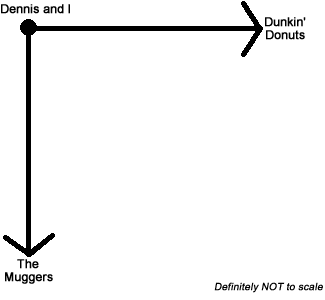
So we left the convenience store. That’s when I asked Dennis if he wanted to hit the local Dunkin’ Donuts on the way home. Now, pay close attention:
Map of Muggers and Dunkin' Donuts
Get ready for this: Dennis didn’t want to go to Dunkin’ Donuts because he wanted to save his money. And Vanity Fair says irony is dead.

So we walked in the direction of the muggers. Only at the time we didn’t actually know there were muggers there, of course. That would have been stupid.

Eventually, we crossed paths with them: Three guys walking on the same side of the street, toward us, making eye contact. We didn’t think anything about it until they stopped us.

Let’s pause here, because this is the part of the story where nearly every white person I have ever met asks the same question. “Were they black guys?” they ask. Or sometimes: “They were black guys, right?” Occasionally, even: “I assume they were black guys.”

So: Yes. They were black guys, okay? Black as the freaking ace of spades. They were considerably blacker than the white prep school boys that, for absolutely no reason, tormented me on the school bus for three years. And much blacker than the white guy who threatened to kill my mother when he held up the convenience store she worked in when I was little. Now kindly insert your head back into your rectum.

Anyway.

They stopped us, and their leader explained that they didn’t want any trouble.

“We don’t want any trouble,” he said. “And we’re real sorry to have to do this. But we’re gonna have to ask you to give us all your money.”

That’s when the guy closest to me took out the gun and pointed it at my stomach. It was a cool gun, actually, one of those guns where you cock it by pulling back on the thing that goes over the part behind the barrel. I wanted to ask him about it, maybe have him show it to me and explain how it worked, but I figured he was busy mugging me and I didn’t want to bother him while he was at work.

Like I said, there were three guys: The Gun Guy, who was next to me, who was likely chosen via some sort of Coolest Afro/Sunglasses combination contest; the Leader, who was likely chosen because he was well-spoken and also very tall; and the Lookout, who was probably chosen because he was the guy who’s all nervous and says stuff like “Guys? I got a bad feeling about this. Guys?”

The Gun Guy took care of me. Leader and Lookout shook Dennis down. Fortunately, I only had two dollars on me, since I had spent the better part of a five-dollar bill on ice cream and some other junk I can’t remember. Dennis had about $50 on him, which Leader and Lookout were more than happy to relieve him of. They took his ice cream, too. They didn’t take mine, probably because it was half-eaten.

There was this one part where the Gun Guy was patting down my pockets and found my house keys. When he asked what they were, I showed him and told him he couldn’t have them because I needed them to get back into my house. He said okay.

In retrospect, this was very stupid. I mean, he had a gun, you know?

So they finished mugging us and we all came back together to close the deal.

“Okay,” said Leader. “Thanks for your time. Sorry to have bothered you.”

He seriously said this.

“Hey,” I responded. “Anytime.”

And we parted ways. Or at least, we tried to. It turned out we were all going in the same direction.

“Look,” said Leader. “You can’t follow us.”

“Well, we’re going this way too,” I said.

“But you can’t follow us.” He was pretty clear on this point. We’re pretty sure the Gun Guy was in his camp too, which made any subsequent discussion purely academic.

“Okay, how about this,” I said. “We’ll hang out here for a few minutes while you guys get going. Then after we’ve given you a sufficient head start, we’ll get on our way.”

Leader thought about this.

“Okay,” he said.

They turned around and walked away. They looked in the plastic bag they stole from Dennis to see what kind of ice cream they got.

So we went home. I was a little shaken up, and so was Dennis. We didn’t call the police, mostly because we forgot.

All in all, it was a pretty good experience, and well worth two dollars for such a cool story. It impresses people, anyway, and I get to feel all intrepid when I check “yes” on surveys that ask if I’ve ever been the victim of a violent crime.

But I guess we failed in our primary goal, which was to get ice cream. I mean, I still had my ice cream after the mugging, but Dennis grabbed it from me and threw it in the gutter when I started gloating about it. So we went out to get ice cream, and came back with none.

And Vanity Fair says irony is dead.

What Art Art?

One of the things that drew me to philosophy was the discipline’s attempt to answer questions that seemed impossible to answer conclusively. I hope the last few articles, which have surveyed some (but by no means all) of the most significant authors in Western philosophy, have shown how this can be a satisfying and useful discipline. Now it’s time to tackle some of those questions ourselves. I’m confident that some — like “Who on Earth thought a sitcom starring Emeril Lagasse would have any artistic merit?” — will never be answered. But even that unanswered question does suggest a more fundamental, and probably more interesting, set of questions — how the devil do we determine what it means for something to have artistic merit in the first place? And what is art, anyway?
Continue reading “What Art Art?”

Who Benefits?

Anyone who paid any attention to the rise and fall of the stock market over the last ten years knows that the “new economy” in and of itself, is not reason enough to do anything – lest you end up a major shareholder in Pets.com. However the competitive environment that came out of that period did lead to some important changes in the way many of us work.

A tight market coupled with a relative abundance of capital made it much easier for workers to demand more from their employers – without fear of losing their jobs. Certain perks like onsite massages and weekly beer and pizza parties (a Silicon Valley software company, of course), are easy to write off as frivolous. However, employees might be less willing to give up perks like tele-commuting, tuition reimbursement, and, a phenomenon that gained tremendous momentum in the nineties – domestic partner benefits.

Recent surveys estimate that the number of U.S. employers extending health and other benefits to unmarried domestic partners (both heterosexual and homosexual) at between 18 and 22%, or roughly 2500 colleges, governments and private corporations. Nearly 90% of those that offer these benefits began doing so in the last five years. As a spokesperson for a Human Rights Campaign, a Washington, D.C.- based advocacy group for gays in the workplace, said in early 2000, “Domestic partner benefits are increasingly becoming a standard business practices in corporate America. Employers have discovered that these benefits help attract and keep the best workers, a critical consideration in the current tight job market.”

Offering a competitive benefits package to attract the best workers may have been priority number one in the late nineties but in late 2001, it is almost certainly not. In a time where economic and other factors led to 199,000 job cuts in September alone, many are wondering if the other merits of domestic partner benefits are enough to sustain them.

What Are Domestic Partner Benefits?

Before we can discuss their merits, perhaps it’s best to describe domestic partner benefits according to the definition found in most employer policies. Domestic partner benefits can include medical and dental insurance, disability and life insurance, pension benefits, family and bereavement leave, education and tuition assistance, credit union membership, relocation and travel expenses, and anything else that spouses and other family members may be entitled to under a company’s benefits policy. While definitions of “domestic partners” can differ from company to company, the basic definition, which is intended to approximate a legal marriage, is as follows:

  • there must be an ongoing and committed spouse-like relationship intended to exist indefinitely, which has existed for at least six months;
  • the partners are not related by blood to a degree of closeness that would prohibit legal marriage in the state in which they reside;
  • neither of the partners can be the legal spouse or domestic partner of any other person;
  • both have shared the same residence for at least six months, are responsible to each other for the direction and financial management of their household, and are jointly responsible for each other’s financial obligations.

Some companies require that the employee and their partner sign an affidavit or other official document attesting to the above or be registered with a local domestic partner registry (if one exists in the area; there is a list available). Some companies also limit DP benefits to homosexual partners using the argument that the law does not prevent heterosexual partners from marrying. For the most part, however, most DP policies apply to all domestic partners and their natural or adopted dependents.

In light of the current economic downtown (and the impact on the workforce), advocates of domestic partner benefits argue that while having a benefits package with a competitive edge was the easiest way to “sell” DP benefits to corporate America, it’s far from the only reason:

Reason 1 – Practice What You Preach

One good reason to offer DP benefits is to enforce a company’s own anti-discrimination policy. If a company has already taken its policy further than the federal and most local governments by also prohibiting discrimination based on sexual orientation, it is, some say, a natural extension to offer gay employees the opportunity to take advantage of all the benefits offered to married couples. This is particularly true since most states do not allow same sex marriages. Until the law recognizes these relationships, some companies may choose to do so in the only way they can. One Philadelphia-area company also attempts to extend this policy to companies it does business with by inquiring about the benefits polices of its clients, vendors, partners, etc.

Reason 2 – Equal Pay for Equal Work

As any employer with tell you, an employee’s take home pay is only a portion of his/her overall compensation. If that employee works full time and is entitled to benefits such as health care coverage, dental coverage, pension plans, etc., these can account for up to 40% of that employee’s total cost to the company. Therefore, someone who is in a committed relationship but not married to their partner cannot receive their full compensation without an inclusive DP policy. This is especially true of pension or life and disability plans, which normally pay benefits to a spouse in the event of the employee’s death.

Reason 3 – Reflecting America

Between the 1990 and 2000 Censuses, there was an over 300% increase in the number of same sex unmarried partner households. Conversely, the number of “traditional” households (comprised of heterosexual married couples and their children) has been declining in the past 30 years, from 40% of the total number of American households in 1970 to just under 25% in 2000. With that in mind, a policy that includes domestic partner benefits is an attempt to better meet the needs of a population that, for one reason or another, is relying less and less upon marriage as the basis of a family.

What About the Costs?

In this era of layoffs and corporate belt-tightening, it may seem unlikely that a company would agree to policy changes that would significantly increase its employee compensation spending. But, as studies among the companies already offering DP benefits, extending existing polices to include domestic partners doesn’t hurt the bottom line and the return on the investment is significant.

Separate studies conducted in from 1996 through 1998 by the International Society of Certified Employee Benefits Specialists and management consulting firms Towers Perrin and Hewitt Associates all show a “minimal” increase in medical claims. Moreover, the costs of covering a domestic partner were no higher than covering a spouse or other dependent. This last point in particular is important because one argument against DP policies has been the fear that costs from covering AIDS and HIV-related illnesses would lead to an increase in the company’s medical premiums. This has not proven to be the case. One reason, says one insurer that also offers DP benefits to its own employees, is that the costs of covering AIDS-related illnesses are not significantly higher than other illness such as cancer, major heart disease, etc. Moreover, in many cases, medical costs for same sex domestic partners is lower than those of heterosexual couples because there are fewer pre-natal, pregnancy, infant care costs to cover.

The overall costs of implementing a DP benefits program tend to stay low because very few eligible partners actually utilize the cost-bearing parts of the programs. Enrollment rates hover around one or two percent of eligible employees. The major reason for this is that a large percentage of same sex domestic partner relationships are dual-income, meaning that partners generally have access to their own health and dental care plans. This statistic, should not, says the HRC, be taken as evidence that DP benefits are unnecessary. Domestic partners who utilize these plans say that the acknowledgment of their commitment is just as important as any financial benefits. One partner said that the plan was worthwhile just because it allowed her to be acknowledged when her partner became seriously ill and was hospitalized. Hospital regulations usually limit visitors to family. Since she was an acknowledged by the company’s medical plan as a domestic partner, she had a convincing argument for hospital staff who would have otherwise barred her from the partner’s bedside.

Secondly, there have been, contrary to many concerns, virtually no instances of fraud in response to the availability of DP benefits. Some argue that an employee could allow “virtually anyone” to get “free or cheap health care” on the company’s tab. As mentioned above, the companies offering DP benefits require employees to meet specific requirements, including affidavits and other sworn statements before any benefits are paid. (Frankly, this is even stricter than what married couples are asked – when signing my husband up for my company’s medical insurance, the HR department took my word that he was my husband. I did not have to show a copy of our marriage certificate.) American Airlines, which only extends DP benefits to same sex partners, requires that the couple pledge to marry, if and when same sex marriage becomes legal, in order to get the benefits.

The bottom line: the economy may have made many workplace perks passé but, as many companies large and small (including these) have shown, domestic partner benefits do have a place in today’s working environment. Companies that are looking to offering them should prepare themselves for a backlash, but can be assured that there are practical, justifiable reasons to help the American workplace keep pace with America.

Brian Bendis: All That and a Bag of Tricks – Part 9

DT: As far as the state of comics in general, who else is out there doing stuff that excites you or that is moving the medium forward?

BB: The cool thing is that more than ever there are a great many people who are moving the medium in spectacular fashion. Everyone’s got very unique sensibilities and take the medium very seriously. Everyone who’s in the comics business isn’t in it for the money. If they make money that’s great. But this isn’t the greatest way to make money that there is, so all the total money-grabbing weasels all left. So what you’re stuck with now is writers and artists that, they have to be in comics. They have to be in comics, all right? We could all be in movies and television or animation. We all could. But we have to be in comics. And so when you have people that have to do it and they don’t care about the money, you’re getting unique interpretations of a lot of characters with unique styles. And also, you’ve got Joe Quesada running Marvel Comics right now, who’s got incredible taste and varied taste in art styles and coloring that you haven’t seen before. He’s willing put someone like Grant Morrison on X-Men and see what happens. It’s taking bold chances.

One of my best friends in the world is David Mack, and I think he is pushing the medium farther artistically than almost anybody out there. He does the covers to Alias and we did Daredevil together for a few issues last year, and I am in awe of his personal growth. Honestly, I’ve surrounded myself with people that I consider to be pushing the medium because I want to be pushed by them and I want to be surrounded by that kind of flavor, and any artist that I’m working with or colorist that I’m working with, I firmly believe is offering everything that they have. They’re not hacking it out, they’re really giving it everything they’ve got.

For your readers who aren’t comics fans, I defy you to go into a comics store and not find something you might want. There’s such an amalgamation of genres and styles and ways to approach a story. When I think of people that go see these pieces of crap movies for nine dollars a pop, and for two dollars you can get a comic that you can keep and read like ten times and be in love with . . . give it a shot.

DT: How do you do that? How do you get the people that aren’t readers to get into the store, go to the bookstore, or whatever?

BB: The best thing I’ve had is mainstream press, I’ve picked up a lot of readers from articles in Spin and Entertainment Weekly’s been real nice to me this year. That’s helped a lot with the bookstores. There are people you’ll never got to go to a comic book store, just like there’s people who go into a comic stores you’ll never get to read a black and white comic. There’s nothing you can do that will turn them. But the proliferation of comics into other places like bookstores and Marvel’s also had, like, you buy a pair of shoes you get Ultimate Spider-Man #1, so we’re like marijuana brownies. “First one’s free, kid!” But not by sitting on our asses and going, “Why won’t anybody love us?”

It is sad that our most popular numbers that comics have done in the last twenty years, in the early 90s, was probably at the medium’s artistic lowest point. Everyone was just hacking stuff out to make as much money as possible, cash grabbing, and all of these people were buying these shallow pieces of crap, and they left. They go, “Why am I buying this crap?” Now, comics are great, and though the audience is there for them, and I love each and every one of them, you do wish all of those people would come back and see how great comics are right now, because they’re just amazing. There are just piles of comics every week that are worth buying. And it’s really bad for guys like me, who have really varied taste in comics. Every week I go, “oh, it’s too many I’m buying. I got into this business to get free comics, where are my free comics?”