Here we go with month 2 of DC’s 1984 output, with the May 1984 cover date on books shipped in February. This is based on what I could read on DC Universe Infinite, so there are a bunch of issues missing again. Overall I’m glad I read these issues, but outside of SWAMP THING there were no home runs. Even my favorites like TALES OF THE TEEN TITANS and LEGION OF SUPER-HEROES let me down a little. A lot of DC’s books this month were perfectly serviceable but most of them are the sort of thing that I would read and then put in my long box and not think about for a long time afterward.
STELLAR SWAMP THING: I started reading Alan Moore’s run on SWAMP THING in trade paperback collections several years ago. I honestly don’t remember exactly how far I got. I’m happy to have jumped back into it with this reading project, that’s for sure because this work really stands out when compared to the other superhero books DC was printing at the time. This month’s issue 24 features the Justice League of America, operating in the background, remarking about how helpless they and the other superheroes are. It creates quite a mood as Swamp Thing has to find a way to reason with the world’s plant life. The artwork matches the writing thanks to Steve Bissette, John Totleben and Tatjana Wood’s work.
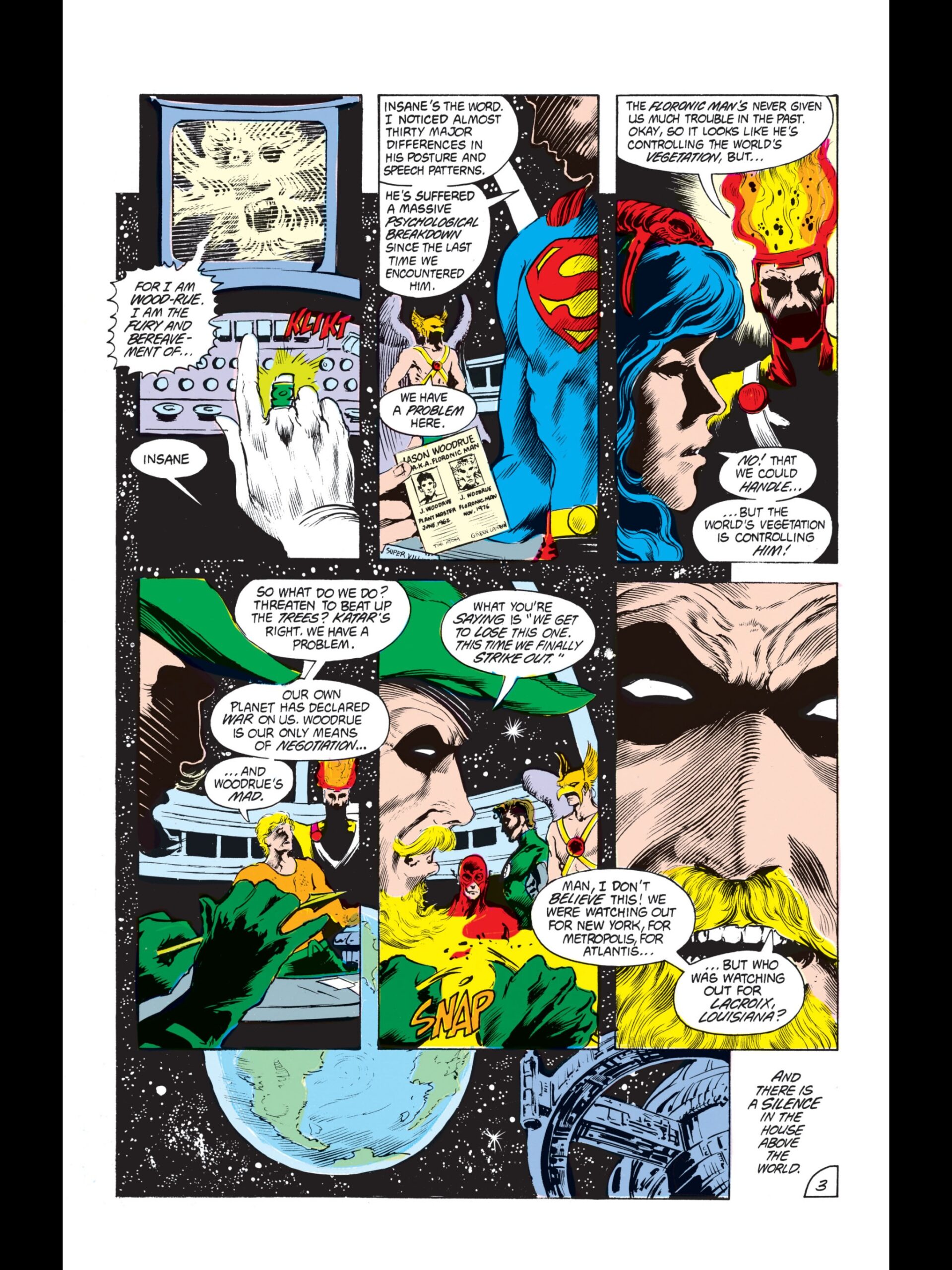
I noticed that these SWAMP THING issues in DC Universe Infinite have a “Conversion by Wildstorm” logo that I have not seen in any of the other digital issues I’ve read. It makes me wonder exactly when this conversion was done, and whether it was done specifically for digital or for a particular printing of the collected editions. I certainly think the colors work well for reading on a tablet, and I am looking forward to more.
HOW TEEN ARE THESE TITANS: I make no secret of my fondness for George Pérez’s artwork or the Teen Titans as characters. And with issue 42, TALES OF THE TEEN TITANS starts one of its most famous stories, The Judas Contract. But this first issue of the storyline focuses on the characters interacting out of battle. While that is often a strength in the series, this issue makes me spend way more time than I want to reading about the inappropriate age-gape relationships that Marv Wolfman and Pérez wrote into the book. Yes, he’s a bad guy doing bad things, but Deathstroke should lose any semblance of being a villain with a code or even an anti-hero as a result of him sleeping with a fifteen-year-old Terra.
Meanwhile, already-divorced failed professor Terry Long is in no way an appropriate match for Donna Troy if Donna is in fact a teenager. Now, I almost talked myself into giving this relationship some slack because I think Wolfman and Pérez are treating the main characters more like young adults – they all live on their own and have jobs; Donna is a successful freelance photographer. So maybe in that light the gap between Terry and her should be seen as smaller and less problematic. And then I thought about this issue having Changeling flirt with Terra and I got the heebie-jeebies all over again. I just wish such a classic series didn’t have this ick factor hanging over it.
EARTH-2 REPRESENTS: Whatever concerns folks at DC had about the multiverse being confusing didn’t stop them from publishing two books written by Roy Thomas set on Earth-2, with INFINITY, INC. joining ALL-STAR SQUADRON. On top of that, the Earth-2 Huntress had a backup feature in WONDER WOMAN. I think that once you take the “daughter of Batman and Catwoman” angle away, Huntress is a costume and crossbow in search of a character, so I’m glad to have a glimpse at the original concept here.
The problem is that I think I like the concept of Earth-2 – a world where in 1984 superheroes had been around since World War II – more than the execution in these books. Especially the first two issues of INFINITY, INC., where characters barge into a room to demand that the Justice Society of America listen to them and then get upset when the barged-upon characters are a little cranky about it. Even in 1984, there were comics with better dialogue and characterization than this.
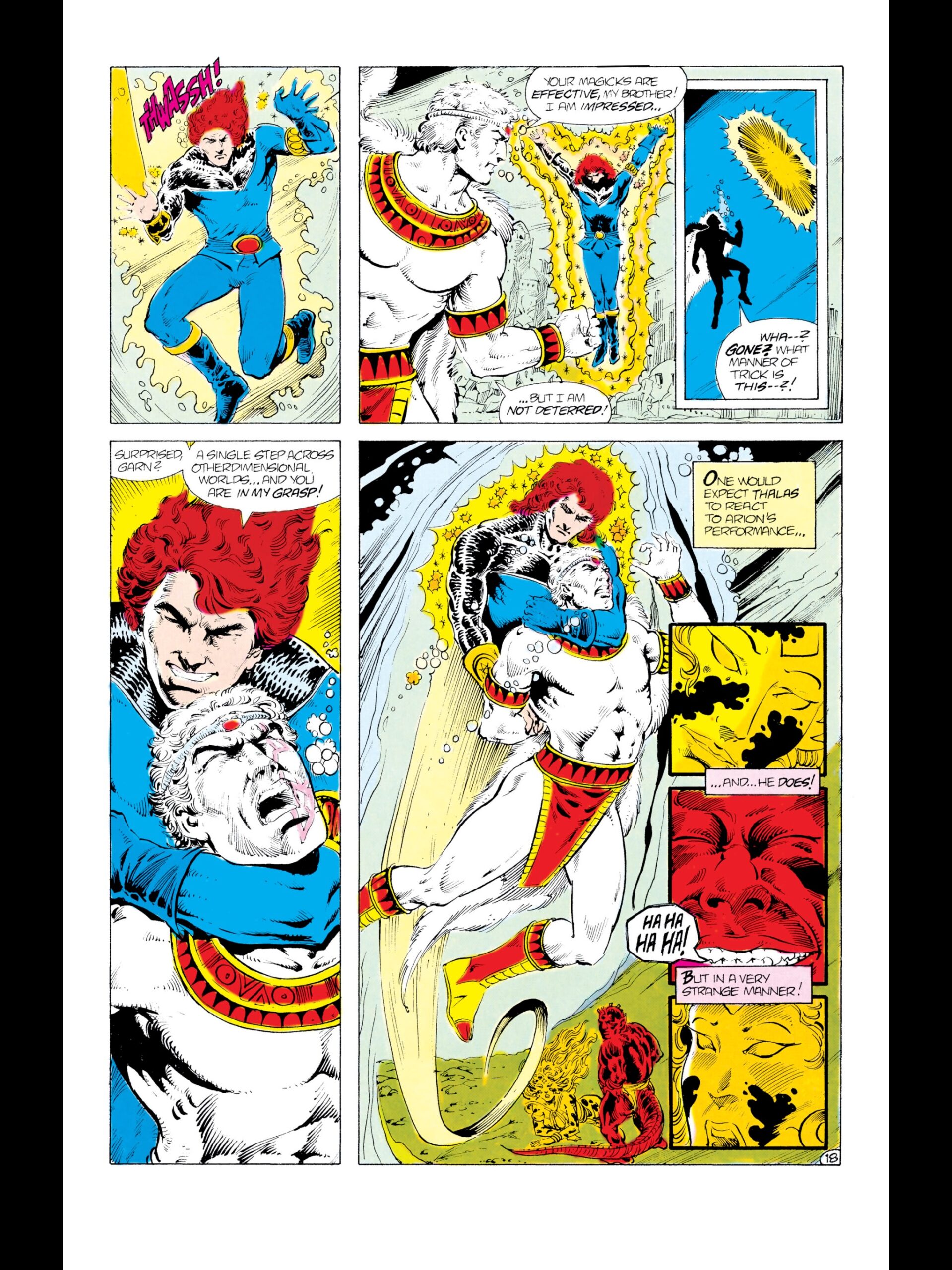
FAVORITES MAKE SOME EARLY APPEARANCES: That said, INFINITY, INC. has artwork by Jerry Ordway, who would go on to work on some of my favorite issues of the Superman books in the 1990s. And ARION, LORD OF ATLANTIS 19 has work from Jan Duursema, who did some great work on Dark Horse’s Star Wars titles in the 2000s. It’s nice to see their work in these early issues. I admit, two issues in to my read, I am still trying to figure out exactly what’s going on in ARION – this is probably the character I am least familiar with, and it seems like Duursema and writer Paul Kupperberg have already built quite a bit of lore in the 17 issues I missed. Of course, today I don’t even have to hit the back issue bins if I want to go back and get into the series from the beginning – I would just have to hit a few buttons on my app. I’m kind of interested in seeing how much I can figure out as I go, though.
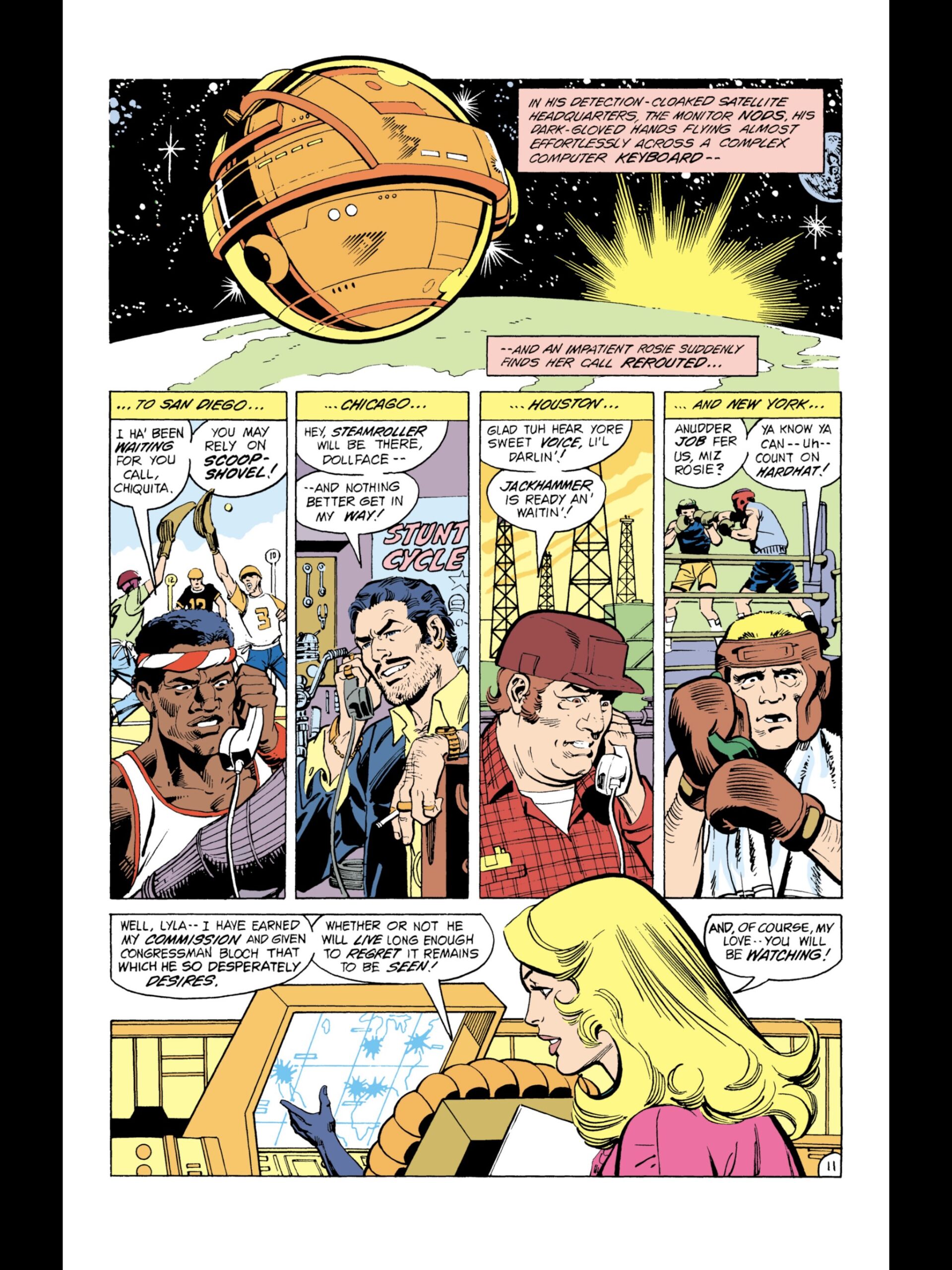
MONITOR MENTIONS: 1984 is the last year before all hell breaks loose for DC, but even early in the year you can see the storm clouds gathering. This month sees two mentions of the Monitor, including an extensive scene in GREEN LANTERN 176 written by Len Wein, who helped to edit CRISIS ON INFINITE EARTHS. The other mention comes in VIGILANTE 6, written by Marv Wolfman. So it’s the folks who were at the center of the planning trying to work in these appearances – which would wind up not quite fitting the more benevolent Monitor who would show up in CRISIS issue 1. But that’s the risk you take when you try to build your reboot plane while the publishing line is still flying.
BAT BOOKS DELIVER: Doug Moench delivers another two part caper in BATMAN 371 and DETECTIVE COMICS 538 that also keeps the subplots moving smoothly. I love this pacing, where you get a complete story in one month but there is also time for characters to evolve a little. I love the characterization of a much healthier Bruce Wayne and Jason Todd. These books are right in a superhero sweet spot for me. So far, of the books I’m reading for the first time, BATMAN and DETECTIVE are the two titles where I like the 1984 status quo better than what I found when I started reading in 1989.

I broke out my print copy of GREEN LANTERN #176 to see what additional context I could gleam from it. These early ’84 issues introduce The Shark, who has become a regular part of the Green Lantern rogues gallery, so certainly there were new things from this era that stuck.
The letter column establishes that fans were already taking notice of the Monitor in GL #173, three months prior to this installment of your review and over a year before the release of CRISIS ON INFINITE EARTHS #1. I can’t help but wonder what the early ideas were for the Crisis and its goal at this point in time as the Monitor is clearly being set up as AN antagonist for CRISIS. Maybe there’s a universe where that vision played out.
This letter column also sports a letter from none other than Beau Smith, the future GUY GARDNER: WARRIOR writer, WYNONNA EARP creator and all around gentleman.
According to the Fandom DC wiki, Monitor’s first appearance is an issue of NEW TEEN TITANS from 1982, which I know I have read and yet I have no memory of.
I know Wolfman mentions in the introductory essay in CRISIS 1 that their concept of the Monitor changed a lot – I will have to look at that piece and maybe the behind the scenes stuff in the Absolute editions to see what exactly was going on. I suspect the idea of the Anti-Monitor came later in the game and changed things up.
I read the battle with the Shark in GL 175 but I did not know the character was being used in more modern books. Cool. (But how do you have something that’s invisible AND yellow?!)