Into Gray: The Moral Murk of the New Star Trek Movie

So over the weekend I got a chance to see Star Trek Into Darkness. I don’t want to do a full-fledged review here, but I will say that I felt about this movie much the same as I did about the first rebooted Trek movie in 2009: It looks great, the writers and actors really seem to get the core of the original characters, and a lot of the dialogue and character interactions are sharp. But the plot and the ideas don’t hold together very well, and as soon as you start asking yourself why A happened, you’re very quickly questioning B, C, and D. Now, a movie isn’t a logical argument, so I had a good time watching each movie despite whatever holes I found in the plotting.

But one thing has been bugging me about the new movie. I can’t figure out the basis for the moral or ethical conflicts that underpin a lot of the character conflicts. So I’m going to talk some of them out here. Needless to say, spoilers ahead.

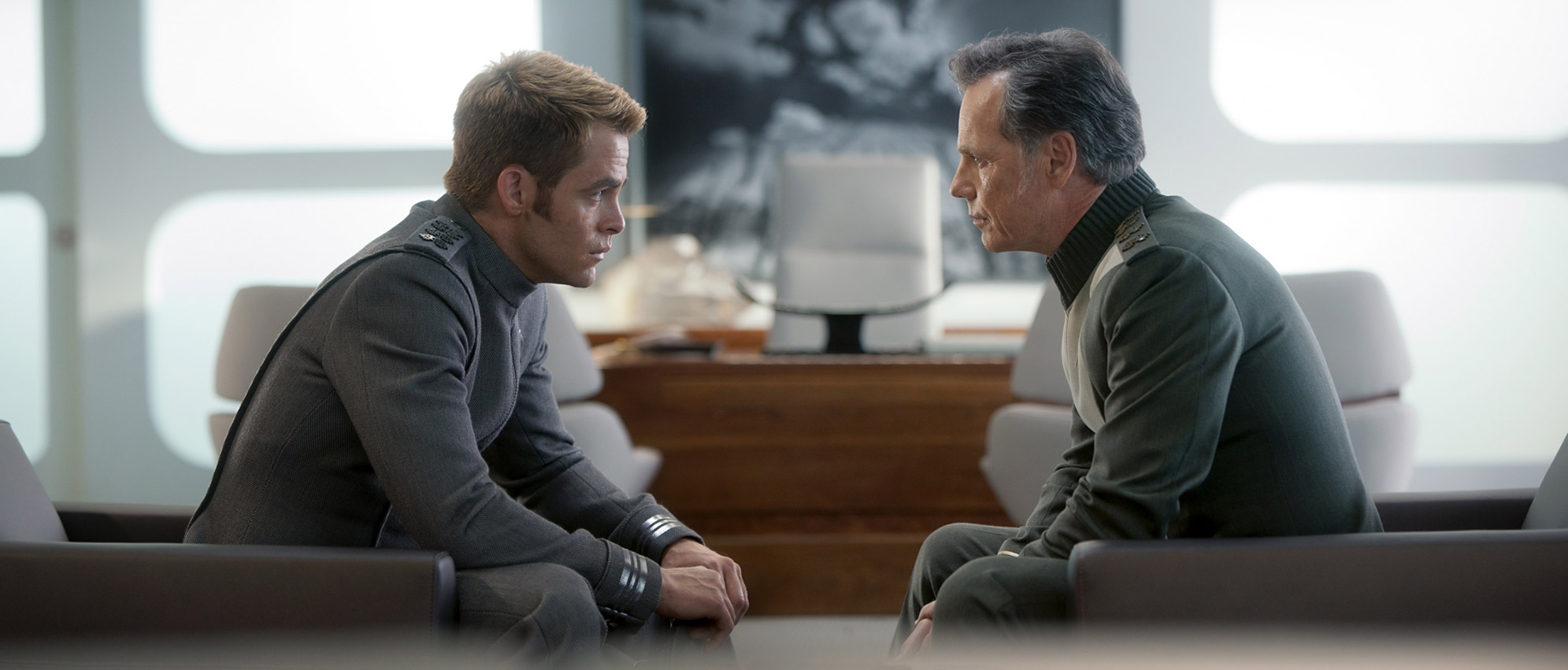
Image Source: www.startrekmovie.com All Rights Reserved by ParamountThe movie opens with the Enterprise on a mission to survey a strange new world. Starfleet’s Prime Directive demands that the crew do nothing to interfere with the planet’s pre-spaceflight civilization, but Spock has figured out that a set of volcanic eruptions is about to wipe out said civilization. So he and Kirk put a complicated plan into motion to lure all of the natives away from the volcano while Spock sneaks in and detonates a device that will render the volcano inert. The plan mostly succeeds, but Spock winds up trapped in the volcano. Due to [insert technobabble here] the only way that the Enterprise can use the transporter to get Spock out of the volcano is to come out of their hiding spot and be seen by the natives. Spock tells Kirk to stay put and follow the Prime Directive, even at the cost of his life. Kirk refuses, saves Spock, and lies about it in his captain’s log. When Spock makes an honest report, Kirk gets demoted and Admiral Pike delivers a lecture about how Kirk is arrogant and unprepared for the captain’s chair.

What I can’t figure out is, where is the grave error in judgment? Was it in trying to save the people in the first place? Are we really supposed to accept the idea that it’s better to let an entire civilization be wiped out rather than take responsibility for interfering with it? Are we supposed to think that Kirk is a hothead because he cares about saving innocent lives?

OK, so maybe the initial interference is OK because they’re going to keep it a secret. But then things go wrong and Kirk has to choose: let his friend and crew member die, or let his ship be seen by people who aren’t yet aware that they’re alone in the universe. Now, Spock thinks he should go for the first option. He’s going to follow the rules, no matter the cost. But Kirk goes for the second option, and then lies about it. Now, he did break a rule, so I guess that’s the sign that he’s not ready to be a captain. And there’s a part of me that sympathizes with that to a point – society has rules for a reason, and if everyone decided to ignore them whenever they felt like it there would be trouble. But sometimes rules come into conflict, and you have to decide your priorities. I know that in the world of Star Trek, the idea of noninterference is called the Prime Directive for a reason. But it seems to me like saving everybody’s life deserves to be a higher priority.

Then again, other characters in the film don’t seem to share that view. The plot moves along with a Starfleet officer accepts an offer from Khan to cure his daughter of a fatal condition. In exchange, the officer mu knowingly set off an explosive that destroys a Starfleet facility. I say knowingly because the officer sends his superior a message right before he causes the explosion explaining his actions. I take it we’re supposed to feel bad for the officer and the impossible situation he was in, and at least understand what he did even if we don’t approve. But the guy knowingly killed dozens of people, if not more, to save his daughter. He did this even after he already had the cure. He did this without trying to find some way to tip people off, or give someone an opportunity to stop him, or even warn someone of what was happening. I just can’t get myself into the head of someone who would say, “Well, this guy just saved my daughter’s life. Guess I’ll go murder a bunch of my coworkers now because he asked me to!”

This attack, and a subsequent attack in which Khan is somehow able to get up close and personal to a meeting of Starfleet’s top officers, provide Kirk an opportunity to get back his command and bring Khan to justice. But through [insert technobabble here], Khan has hidden himself away on the Klingon homeworld. So gung-ho Admiral Marcus tells Kirk to go fire a bunch of super-duper proton torpedoes at the Klingon homeworld and kill Khan. Kirk is willing to do it, but Spock and others urge him not to. So he changes his mind and instead orders a landing party to go to the planet and get Khan themselves.

OK. There seem to be two main objections to firing the torpedoes. The first is that killing Khan without a trial violates his rights. I get that, and I can appreciate that the capture option eliminates that problem. But the other objection is that firing the torpedo is an aggressive action that might lead to war with the Klingons. So instead . . . Kirk violates the treaty with the Klingons, invades their territory, and kills many of them (with Khan’s help). How was that a better option? It seems like the only way that could work better is if Kirk’s team had captured Khan without being detected. And that’s not only a long shot, it implies that the ethical problem isn’t the action of violating the treaty, but instead is the action of getting caught. (Which would seem to justify Kirk’s attempt to hide his violation of the Prime Directive at the start of the film, by the way.)

I could handle some of my confusion here if I felt like it were part of a worthwhile character arc, but for the life of me I can’t figure out what Kirk has learned or what makes him a better captain at the end of the film than at the start. He’s still willing to break rules. He’s still willing to trust his gut instincts. He’s still fiercely loyal to his crew and friends. He’s humbled by circumstances when he meets some enemies he can’t outshoot or outthink, but I don’t see where his attitude changes. So the lack of a clear ethical position seems to contribute to the lack of a clear story, and that’s unfortunate.

Now, it’s entirely possible that I am overthinking this. It would not be the first time. So if you have a take on the movie, especially the ethical problems its characters face, I’d love to hear your thoughts.

Off the Island

From the continuing exploits of the board game playing Thomer-Gillett family:

Today we tried out Forbidden Island, another cooperative game. I first heard about the game after the Tabletop episode Pandemic. I like cooperative games where the the players are working together to achieve a common goal, but trying to stop the global spread of disease seemed like too much of a downer of a theme. Wil Wheaton suggested on his blog that Forbidden Island had similar mechanics but might be less grim. After my daughter had a good experience playing the game on Tabletop Day on Saturday, we decided to give it a try.

Considering that the object of the game is to escape from an island before it sinks, I’m not sure it’s substantially less grim than stopping a global disease, but it was fun. We managed to win the game pretty much on our last turn. So we cued up the Raiders March on Pattie’s iPhone as we made the last move to escape the island. It’s definitely a worthwhile game if you’re looking for something that a group can play together.

Shifting Sagas

I’ve loved epic stories for as long as I can remember. As a first grader I would race home from school so that I could get to the TV in time for Star Blazers, an English version of a Japanese series that featured a desperate starship crew trying to find a way to rescue Earth from irradiated extinction. I spent hours playing with Star Wars toys even before I got the chance to see the movies. I collected monthly superhero comics for almost twenty years. As television offered more intricate serializations, I threw myself into series like Babylon 5 and Farscape. The grander and more elaborate the storytelling, the happier I tended to be.

I’m writing this paragraph in my local Barnes and Noble, where the amount of epic fiction available boggles my mind. There are shelves full of graphic novels; the children’s book section is teeming with adventure and fantasy series. There are undiscovered movies and TV series over in the DVD section that I will probably never get to because I can’t even keep up with all the old series that I can watch on Netflix, let alone the new series that the service is ramping up. I would have gone out my mind if something like this had existed when I was in grade school.

And yet over the last five or ten years, I’ve mostly been filling my appetite for epic narrative in an entirely different medium. I dropped out of Lost and Battlestar Galactica midway through each series and have never found the motivation to go back, even though both are easily available through Netflix. I still buy several trade paperbacks every year, but it’s not the regular ongoing habit that it was for so many years. I devoured all seven Harry Potter books in about a month several years ago, and that’s been about it for my fiction reading. These days, when I want to visit another world, I tend to turn to my computer and play a game.

The use of narrative in computer games has gotten a lot of attention in recent years, and I’ve noticed a lot of the writers I followed in TV or comics also do work on video games. There’s long been some aspect of a story in video games – giving the player a motivation for what they’re trying to accomplish in the game creates more engagement than just saying, “We want to test your eye-hand coordination” or “Here’s a bunch of logic puzzles.” But I’m not going to say I was ever that absorbed in whether or not Mario would find the princess, so “Sorry Mario, the princess is in another castle” never hit me the way a really good cliffhanger would. But I feel like the writing and the story of the game world is becoming more important, not just in the amount of tie-in fiction available but in the game itself.

Now to some extent, story is still a dressing on a game that doesn’t really require it. I played LucasArts’s TIE Fighter a lot when I was in college, and there was a single player campaign that tried to put each mission in the context of the player’s growth as a pilot and the Empire’s continued effort to thwart the Rebel Alliance. But you could easily just play the missions without paying any attention to the briefing. When I play Rock Band with my daughter, there’s a veneer of a story about our band playing bigger venues and getting more resources, but you can just as easily just play a random bunch of songs. So as much as I enjoy playing those games, they don’t have the same kind of engagement that a story does.

In other games, there’s no story provided, but the game provides the raw material for me to come up with one in my head. I have spent a lot of time on the Civilization series of strategy/simulation games over the last few years. Each game can form the basis of a story of an empire’s rise (and often fall), but there are no real characters in the game – even the avatars of leaders that the game uses don’t seem to have any real psychological life, and you never have to confront the damage that constant warfare or technological change wreak on the citizens of your towns – those things are represented as numbers and game elements, but there’s nothing personal about them. And yet, I enjoy playing these games because each game is unique, and my curiosity about what happens next is increased because nobody knows what will happen next, and my decisions in the game will help affect the outcome. I am not just an observer, but I am also a participant in a way that I can not be when I watch Babylon 5 or Star Wars, even if the latter give me a richer character experience.

Beyond sim games, there’s a growing genre that tries to combine active participation with character development and emotional engagement. For the last six years I have been a tremendous fan of the games produced by a studio called BioWare. The studio is famous for its version of computer role playing games. I tried a few example of the genre back in the 90s, but I never really got into them because the games I tried focused more on the stat-building part of role playing, and I couldn’t get engaged in the fights I was getting into. BioWare put an emphasis on character and story into its games, surrounding my player character with a group of companions who had their own agendas and who reacted to my choices in the game.

It’s amazing to me how well this worked. My first BioWare game was Star Wars: Knights of the Old Republic, which I’ve talked about on the site before. I loved progressing my character and his or her relationships with the companions. The combat parts of the game almost became an afterthought – I enjoyed them well enough, but they were something I did in order to get to the next conversation. Replaying the game was similar to rewatching or rereading my favorite stories, with the added benefit that I could change the outcome if I wanted. And because I had to make those choices, I thought a lot about the characters and what they wanted, and whether they were justified in their actions. Knights of the Old Republic, in particular, explored some of the questions of identity and agency that I’ve enjoyed thinking about in science fiction movies and TV shows. So I was getting a lot of similar narrative stimulation, with the added bonus of being a participant and not an observer. It’s that double-feature that keeps pulling me to the PC instead of the TV.

Since Knights of the Old Republic I have played and replayed a lot of BioWare games, along with similar games from other developers. In particular, BioWare’s Mass Effect series has been at the center of my fandom for the last five years. Mass Effect took its interactive narrative to a whole new level. Across three games, released for the PC between 2008 and 2012, the player controls Commander Shepard as he explores the galaxy and first discovers, then tries to fight, an ancient threat to interstellar civilization. Choices from the first game carry through the first and second, changing the characters that you meet and the opportunities your character has. By the third game, conflicts that date back centuries are brought to a head and Nothing Is the Same Anymore – and in fact, nothing might be the same in my game as in your game, because of the different choices we made. The conversations the characters have between missions make them feel as real as characters in TV and movies, and their triumphs and failures resonate. It’s an amazing accomplishment that I will probably want to talk about in its own post. But the Mass Effect story has absorbed me just as much as Star Wars and B5 have over the years.

Now, don’t get me wrong – this is still a developing storytelling medium. The technical challenges of branching storylines offer a lot of potential for the control that they give to the player to shape the story, but they also impose limitations. You can go to YouTube and watch playthroughs of Mass Effect and other story-driven games, but if you do, I don’t think you’re going to find them on par with the latest Pixar film in terms of character animation or with a TV series like Battlestar Galactica in terms of dialogue and character development. Right now, the personal engagement and control are helping to make up for the shortcomings in those areas. Over the next decade or two, I will be fascinated to see if technological growth and years of practice are able to bring the best of all worlds together.
When the Board Is a Tablet

My daughter and I both enjoy playing board games, and Ticket to Ride is one of our favorites. Recently she got the iPad version, and we play that sometimes because by adding computer opponents, the game actually gets a little easier. The game has a rules tweak when you go from 2 or 3 to 4 players, and Alex in particular likes to play with that tweak. The iPad version is very nicely done – it handles all the bookkeeping and conveys the game’s information well. But there is something a little lacking about the experience. In order to allow each player to maintain secrecy about his or her hand, only one person can look at the iPad at any one time. So you lose that sense of engagement when it’s not your turn – you can’t look at your cards, or look at the board, to plan your next move and try to think about where the other players will go. And I like that part of the tabletop game playing quite a bit. (Pattie posted a picture of me playing the physical version a year or so ago on Facebook. My cousins immediately replied, “I know that face.” So this is a longstanding habit.) Don’t get me wrong, I’m glad to have the option to play the game without needing a bunch of cards or setup. But I think this is one of those things where the analog experience still has some value.

The Power of Words

Dave Barry is the reason I wanted to go into journalism for a very long time. One of the highlights of my college career was the year I wrote a weekly humor column with a voice that was very much inspired by Barry’s column. But I was almost always impressed when he turned to serious subjects. His “Greatest Hits” book included a eulogy he wrote for his father. It’s stuck in my head since I read it in grade school. Over the last couple of weeks it’s been in my head even more. So I thought I’d share it here, as an example of what writing can do. It’s called “A Million Words” and it’s available on Barry’s website as a PDF. Here’s the link.

One Too Many Hits to the Head

I mostly stayed away from watching football during the regular season, but I drifted back to check out the playoffs. So I’m glad that Ta-Nahesi Coates keeps putting together pieces like this to remind me of the consequences of what I’m watching. When Pattie and I listen to sports radio on the drive to work, we hear a lot of people say that they wouldn’t trade their experiences playing football for anything, despite the consequences. I can’t see myself ever being willing to make a trade like that . . . so if I can’t, is it ethical of me to derive enjoyment and/or produce profit based on others making a different decision? And does anyone have an obligation to try to interfere with their ability to make that decision, and take it out of their hands?

Been thinking about it for a while. Gonna be doing so for quite a while longer, I think.

What Magic Is This?

Just stealing an item I posted on Facebook:

Just got an email from Amazon saying that tracks from many of the CDs I bought from Amazon since 1998 can now be downloaded as MP3s trough their Cloud Player. Do they think I’ve been sitting here with the CDs on my desk for the last ten years, looking at them, then looking at the computer, saying, “If only there were some way to make the digital information on these discs available to my computer! Sadly, such wonders are far beyond the ken of mortals such as me!”

The kicker is, some of the CDs that Amazon has in my “bought” registry were puchased as gifts. So now I have MP3 copies of songs I never actually wanted in my cloud player along with what must be my 15th cop of Losing My Religion. (I have one in the corner, and one in the spotlight . . .)

If I were using Cloud Player instead of iTunes, and if I were buying CDs instead of digital copies, the AutoRip feature might be useful going forward. And I suppose it’s nice to know I have a backup backup if I lose my digital files AND my CDs. But this seems like a lot of work for Amazon to implement for a feature that just adds even more digital clutter to my life.

Not Completely Stuck in the 90s

My fondness for 90s alt-rock is pretty well-known, and with an iPod library well over 1000 songs I’m not actively looking for new music as hard as I used to. Plus, I don’t listen to the radio a whole lot, and even if MTV were playing music videos I don’t have cable anymore. So the opportunities to find new music have narrowed a lot.

However, now that the family commutes to and from school in the car, I do have a few chances to listen to the radio, and when the commercials on sports radio get unbearable I sometimes switch the station to Radio 104.5 Their playlist is a decent mix of a lot of stuff from the grungy side of the 90s (a decade the oldies and classic rock stations have not quite gotten up to yet) and current music that doesn’t sound out of place with the older stuff. I actually discovered two songs that have become staples of my “Oh God I need to wake up” routine:

There’s Morning Parade’s “Headlights”:

And Of Monsters and Men’s “Mountain Sound,” whose lyric “We sleep until the sun goes down” sounds like an awfully good idea to me:

Also, I do listen to Pandora on occasion. And for the most part, Pandora has me pegged pretty well, with a heavy diet of R.E.M., Matthew Sweet, Neil Finn and Crowded House, and other artists I’m familiar with. But it has occasionally given me a song I didn’t know, like Don DiLego’s “Falling Into Space:”

So maybe there’s hope for me after all. 🙂

It’s Liberty Valance All Over Again

To me, one of the biggest themes of the 2012 election was the conflict between narrative and data. Pundits, campaign officials, and traditional press focused on telling a story throughout the year, with important decisions and turning points, changes in momentum, and an uncertain conclusion. Political scientists and a lot of data-driven analysts tried to counter this portrayal by highlighting data that pointed to a fairly stable and consistent electorate. Nate Silver of FiveThirtyEight got a lot of attention for this, and I was one of many people who picked up and eagerly read his book The Signal and the Noise. (I really need to write a review of the book, because it’s probably one of the most important works about philosophical pragmatism that never mentions philosophical pragmatism.) I’ve also been enjoying the blog The Monkey Cage, where a group of political scientists share their opinions with a general audience. (I really need to write a post about the blogosphere being the new home of the public intellectual, because it’s probably the best place for citizens to build the civic literacy required for a flourishing democracy.) The data folks generally did well with their predictions, and the political scientists have even called some of the spin/postgame analysis from the Obama campaign into question.

But that has not stopped the political press from looking for a good story. On Nov. 8, Politico started previewing the 2016 presidential election, suggesting that

a more familiar political order is poised to reassert itself: the House of Clinton representing Democrats and the House of Bush atop the GOP.

Besides the lunacy of previewing an election four years before it happens, this is just a ridiculous statement. It’s trying to suggest that these two rival families have been fighting for decades, only taking a break in 2008. But a Bush has faced a Clinton in a presidential election exactly once, in 1992. It’s not exactly the Hatfields and the McCoys.

The article tries to make it look like it’s using data, but it doesn’t stop to let the data get in the way of the narrative it’s building:

The 2012 contest was notable for being the first presidential campaign since 1976 that didn’t feature a member of one of America’s most famous political families.

OK, so in order to make this work we have to count Hillary’s run in the 2008 primary and George H.W. Bush’s runs as the vice presidential candidate in 1980 and 1984. It’s a bit of a stretch, but we can work with it. That certainly sounds like these two families have been a constant presence in American politics for three straight decades.

The problem is that it’s a brilliant example of the idea of false equivalency – the idea that the press will take an action or event on one side of the political spectrum and treat as nearly identical to something on the other side of the spectrum, even when the resemblance is slight.

The quote covers the elections of 1980, 1984, 1988, 1992, 1996, 2000, 2004, and 2008 – eight in total. How many of them featured a Bush? Six – all of them in the general election. George H.W. Bush ran for VP in ’80 and ’84 and for president in ’88 and ’92. Then his son George W. Bush ran for president in 2000 and ’04. It’s hard to argue that that’s not a pretty significant percentage, so the idea that Bushes are an important family in the Republican Party makes some sense – although really, what’s remarkable is how many elections Bush 41 was in. He was in half of the elections in question even before you add his son to the mix. But if you want to be more impressed that the House of Bush was on top of the GOP for 4 elections, I can’t argue with you.

OK, so what about the Clinton family? Do they have a similarly substantive record of running in presidential elections? Heck no. Between Bill and Hillary, they’ve run in three elections and only two generals. Bill’s presidential runs in ’92 and ’96, plus Hillary’s primary run, and that’s it. Walter Mondale ran in three general elections. Al Gore ran in three, and got involved in a fourth primary. The House of Carter and the House of Obama have both been on top of the Democratic Party just as often as the House of Clinton, and I don’t see anyone speculating that James Carter IV or Michelle Obama are going to return to their family’s traditional spots atop the party in four years. (If you have seen someone say this, please, let me enjoy my ignorance.) There is just no way to make the Clinton family an equivalent of the Bush family using facts, but the media has built up so much symbolism around the names that they assume their readers won’t care about the facts – they just want to keep reading about the legend.

What I (Over)Think and What I Feel About “The Muppets”

We saw The Muppets last week. I think it’s the first Muppet film I’ve seen in a theater since the original Muppet Movie, and I am not even 100 percent sure that I saw that one at the movies. If you want to know what I think about the movie, keep reading. If you want to know how I feel about it, skip to the last paragraph.

The Muppets is definitely a throwback to the original film – the characters are trying to put on a show while also being aware that they’re in a movie about them trying to put on a show. The breaking-the-fourth-wall and entertainment inside humor are the source of many of my favorite jokes in the film. The story and the character development serve mainly as pegs for the humor – they’re all drawn very broadly and don’t have a lot of room to develop. Conflicts are introduced and quickly resolved before the audience has a chance to really get invested in them.

The one character element that I had a problem with is that Kermit seemed a bit passive in the film. He needs to be prodded into doing just about everything, and there’s an untold story about how Kermit let the gang drift apart in the first place. He rallies a bit toward the end, but as someone who’s always liked Kermit, I felt a little let down.

The interesting theme of the movie is that the Muppets have been out of action for so long that they’re out of fashion and ignored. So they have to prove to themselves and the world that there’s still a place for their kind of entertainment. The movie plays up the idea that the Muppets are stuck in the 80s, even introducing a character called 80s Robot. It was a little weird to me to see this element. The Disney Muppets had a TV show and several theatrical movies in the 90s. They made a couple of TV movies and several viral online videos in the 2000s. I felt like the movie ignored all of that and pretended that the Muppets went dormant after The Muppet Show ended and The Muppets Take Manhattan left theaters. By all means, the movie is free to pick and choose its continuity – it’s not like there’s ever been a single coherent canon for the characters – but the meta theme didn’t totally click with me.

All of that said, toward the end of the movie, Kermit and the other Muppets perform “The Rainbow Connection,” and Alex started to sing along. In that moment, The Muppets became one of the most joyous experiences I’ve ever had in a movie theater, and left no doubt that there’s still a place for these characters.