Author Archive

Crime Pays (At Least a Little)

Posted October 1, 2001 By Kevin Ott

OK, so you’ve heard the one about the guy who gets called for jury duty a week before his vacation and has to put off all the classes he’s teaching. At least, I hope you have. If not, you seriously need to go back and read it. Dave wrote it last month. Or maybe the month before. Probably the month before. But go read it, because it’s pretty good. Better than this story, anyway.

But they’re both about crime, which is the topic of today’s Humor column. Because crime can affect YOU, mister smarty pants. Yeah, you. With the Doritos. Put ’em down and listen.

This is a story about how crime can strike anyone, at any time, even in the middle of a major metropolitan area with a high crime rate at 3 a.m on a deserted street with no cops around. It’s the story about how one time I went out for ice cream and lost TWO DOLLARS to a roving gang of armed bandits. It’s the story of a boy and a horse, and their love for one another. And it’s all true, except for the part about the horse, which I just made up right now.

It was the summer of 1993. Bill Clinton was firmly entrenched in the White House and a young rapper named MC Hammer was well on his way to abject poverty. I understand he’s some sort of minister now. So it just goes to show the curveballs life can throw you sometimes.

I had just graduated from high school and had my entire life ahead of me. Well, except for the part that had already occurred, which was actually behind me, if you want to get technical. I was at home with my friend Dennis, who had come to spend the night at my house because my mother had gone somewhere for the weekend and didn’t want me getting into trouble.

Remember that: My mother didn’t want me getting into trouble. And Vanity Fair says irony is dead.

So after a long night of playing fantasy role-playing games and watching premium-channel soft porn (Remember: High school! I’m actually very cool now! And quite successful with the ladies!), Dennis and I decided that some ice cream would hit the spot. So we struck out for a local convenience store, not really thinking that it was 3 a.m. and the muggers clocked in at about midnight. Hours of fantasy RPG and The Red Shoe Diaries will do that to you.

I bought one of those ice cream sandwiches where it’s actually two chocolate chip cookies with ice cream in between them. Dennis bought the latest LSD-inspired flavor from Ben and Jerry. Shine on, you crazy diamond!

So we left the convenience store. That’s when I asked Dennis if he wanted to hit the local Dunkin’ Donuts on the way home. Now, pay close attention:
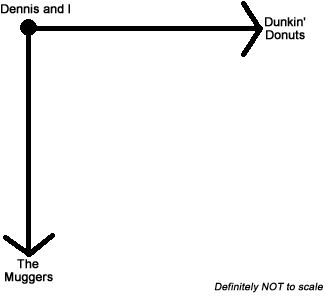
Map of Muggers and Dunkin' Donuts
Get ready for this: Dennis didn’t want to go to Dunkin’ Donuts because he wanted to save his money. And Vanity Fair says irony is dead.

So we walked in the direction of the muggers. Only at the time we didn’t actually know there were muggers there, of course. That would have been stupid.

Eventually, we crossed paths with them: Three guys walking on the same side of the street, toward us, making eye contact. We didn’t think anything about it until they stopped us.

Let’s pause here, because this is the part of the story where nearly every white person I have ever met asks the same question. “Were they black guys?” they ask. Or sometimes: “They were black guys, right?” Occasionally, even: “I assume they were black guys.”

So: Yes. They were black guys, okay? Black as the freaking ace of spades. They were considerably blacker than the white prep school boys that, for absolutely no reason, tormented me on the school bus for three years. And much blacker than the white guy who threatened to kill my mother when he held up the convenience store she worked in when I was little. Now kindly insert your head back into your rectum.

Anyway.

They stopped us, and their leader explained that they didn’t want any trouble.

“We don’t want any trouble,” he said. “And we’re real sorry to have to do this. But we’re gonna have to ask you to give us all your money.”

That’s when the guy closest to me took out the gun and pointed it at my stomach. It was a cool gun, actually, one of those guns where you cock it by pulling back on the thing that goes over the part behind the barrel. I wanted to ask him about it, maybe have him show it to me and explain how it worked, but I figured he was busy mugging me and I didn’t want to bother him while he was at work.

Like I said, there were three guys: The Gun Guy, who was next to me, who was likely chosen via some sort of Coolest Afro/Sunglasses combination contest; the Leader, who was likely chosen because he was well-spoken and also very tall; and the Lookout, who was probably chosen because he was the guy who’s all nervous and says stuff like “Guys? I got a bad feeling about this. Guys?”

The Gun Guy took care of me. Leader and Lookout shook Dennis down. Fortunately, I only had two dollars on me, since I had spent the better part of a five-dollar bill on ice cream and some other junk I can’t remember. Dennis had about $50 on him, which Leader and Lookout were more than happy to relieve him of. They took his ice cream, too. They didn’t take mine, probably because it was half-eaten.

There was this one part where the Gun Guy was patting down my pockets and found my house keys. When he asked what they were, I showed him and told him he couldn’t have them because I needed them to get back into my house. He said okay.

In retrospect, this was very stupid. I mean, he had a gun, you know?

So they finished mugging us and we all came back together to close the deal.

“Okay,” said Leader. “Thanks for your time. Sorry to have bothered you.”

He seriously said this.

“Hey,” I responded. “Anytime.”

And we parted ways. Or at least, we tried to. It turned out we were all going in the same direction.

“Look,” said Leader. “You can’t follow us.”

“Well, we’re going this way too,” I said.

“But you can’t follow us.” He was pretty clear on this point. We’re pretty sure the Gun Guy was in his camp too, which made any subsequent discussion purely academic.

“Okay, how about this,” I said. “We’ll hang out here for a few minutes while you guys get going. Then after we’ve given you a sufficient head start, we’ll get on our way.”

Leader thought about this.

“Okay,” he said.

They turned around and walked away. They looked in the plastic bag they stole from Dennis to see what kind of ice cream they got.

So we went home. I was a little shaken up, and so was Dennis. We didn’t call the police, mostly because we forgot.

All in all, it was a pretty good experience, and well worth two dollars for such a cool story. It impresses people, anyway, and I get to feel all intrepid when I check “yes” on surveys that ask if I’ve ever been the victim of a violent crime.

But I guess we failed in our primary goal, which was to get ice cream. I mean, I still had my ice cream after the mugging, but Dennis grabbed it from me and threw it in the gutter when I started gloating about it. So we went out to get ice cream, and came back with none.

And Vanity Fair says irony is dead.

They Shoot, They Score

Posted September 1, 2001 By Kevin Ott

The Music We’ll Always Remember, The Scenes We’d Like to Forget

Remember the 80s? Sure you do! Remember those great John Hughes movies that we all loved and identified with as wealthy white suburban kids? Remember that one scene in that one movie when John Cusack or possibly one of those actors named “Judd” held up a stereo outside of his girlfriend’s window, and then some other stuff happened? Remember that? Remember? Wasn’t it great? Remember?

Shut up. Of course it wasn’t great. It was monumentally stupid, watching someone who had the potential to be a good actor standing there dressed like a Street Person, holding up a boom box in the middle of a suburban development, thinking this was a viable way of getting a woman to like him. It was awful.

But the song. Read the remainder of this entry »

Left of Center

Posted April 1, 2001 By Kevin Ott

Lots of times, political cartoons just manage to get me all peeved and make me throw the paper down on the table and want to just say “screw it all” and watch Friends just to avoid being a part of the political process.

See, I hate political junkies. I hate TV pundits, I hate most political columnists, I hate political reporters who think that they’re actually writing for an audience that includes more than just a bunch of other political reporters.

That’s why Scott Bateman is so freakin’ cool.

Bateman is my political cartoonist, and your political cartoonist, and he’s part of this really cool vanguard of young political commentators that focus on how our elected leaders actually affect us, as opposed to making symbolic graphical platitudes about school violence or campaign finance reform. In a Bateman cartoon, you’ll never see a big whale labeled “foreign policy” with whoever happens to be president at the time dressed as Ahab, running after it with a harpoon labeled “tax cut,” or a cherry tree labeled “education initiative” and some senator dressed as George Washington holding an ax labeled “tort reform bill,” or something equally cryptic and completely unfunny. Reading Scott Bateman’s work, it looks like he realized a long time ago that guys like Berke Breathed and Garry Trudeau and Bill Watterson had it right: Tell a good story in pictures, and you’ll make a great point, and people will laugh. It’s that easy.

More recently, Bateman has been creating and posting his very own Web animation, which often deals with more everyday pop-culture situations, like his “Coffee Achievers” strip does. But you know what? I suck at describing this. Go to his website to find out how cool he is.

Bateman was also cool enough to answer some questions for notnews. Here they are: Read the remainder of this entry »

Do You Didgeridoo?

Posted March 1, 2001 By Kevin Ott

The diversity of musical forms offered by the native peoples of the world is nothing short of impressive: From the Toltecs of Central and South America, who lull us with their haunting flute melodies, to the pounding drums and rhythmic chants of the Amerindians, to the water drums played by the Baka people of Cameroon, to the Australian Aborigines, who make instruments by blowing termite poop out of tree limbs.

Seriously. One of the most beautiful, haunting sounds carried along frequencies accessible to human ears comes from an instrument which, in its truest form, is created by hungry insects.

I’m talking, of course, about the didgeridoo, also called the didjeridu and, for some reason, the yadiki. Raw, earthy and practically subsonic, the didgeridoo figures centrally in Aboriginal music, and is a strong image in the culture of the Island Continent. Read the remainder of this entry »

Burials and Understandings

Posted February 1, 2001 By Kevin Ott

Death is a strange bird. No matter what you do, no matter how you prepare, no matter how well you think you’ve dealt with the immutability of the eventual demise of someone you love, you’re always surprised when it happens. You’ve watched the jocular weatherman’s five-day forecast, you see the clouds coming, and you wear the raincoat and open the umbrella and roll up all the car windows, but somehow you still get wet. Soaked. Sopping.

This is what ran through my head as I was mopping tears off my cheeks a few weeks ago, and looking down at my cat, who had just expired on a stainless steel table in a veterinarian’s office. Since the night before, when I found her in front of our other cat’s water bowl, suddenly underweight and stinking of litterbox, I knew there was something rotten in the state of Mavis.

When I took her to the vet and he said immediately that she was critically ill, I knew I was going to have to make The Decision. When he prodded her kidneys and said he couldn’t tell them apart from the other organs, I knew I’d be driving home alone. When he showed me the x-ray, and told me her kidneys had somehow ballooned to the size of lemons when they should be about as big as a pair of dried apricots, I gulped and made the final arrangements in my head: Someone who has been my roommate for the past three years is going to die.

I’d known it all day, and I’d gone to bed thinking it the night before. I didn’t hide from the truth; in general, I’m naturally pessimistic and cynical to the point of wondering if the whole universe is just a big joke on me, so I wasn’t expecting any miracles. I was emotionally prepared for this. I opened the umbrella.

I got soaked.

Since then, I’ve thought of Mavis’s last minutes, prodded and probed and punctured on a cold table with a glass rod full of mercury in her rectum. I’ve thought about how she yowled when the technicians had to push on her bladder to make her pee in a vial. I’ve thought about how she yowled louder when the vet wrapped a tourniquet around her foreleg because he couldn’t find a vein. I’ve thought about how melodramatic I must have seemed afterward, slumping over the table and blubbering into her fur, even though I was still alive and comfortable and it was Mavis who had spent the last hour on a table in a lab, excreting water faster than she could drink it and facing the business ends of needles and rectal thermometers and unfamiliar fingers.

I thought of the signs of her illness that I should’ve seen but didn’t. I was changing the kitty-litter twice as much as usual; I’d just figured Mavis had developed some sort of litterbox treaty with Simba, the other cat, who she normally hated. Mavis started peeing when I was in the room, something she — a former stray — had always been too defensive to do; I thought maybe she was finally letting her guard down around me. I thought of how she had seemed just a little too uninterested in me, or food, or anything, over the past few weeks.

But I also thought of the time when she brought a sparrow, squawking like the Dickens, from the balcony and placed it in front of me in the bathroom and then sat there proudly, maybe waiting for me to stick it to the fridge with a magnet or something. When the sparrow tried to hop away, she would bat it down with a paw, then look at me again, with the same I-done-a-good-job-boss look on her face, like I was a Casa Nostra boss and she an up-and-coming kneecap-breaker.

And the times when she would curl up in bed next to my head and purr loudly and sometimes knead the pillow, tearing the pillowcase to shreds, and I would say “DAMMIT MAVIS I am trying to SLEEP!” and she wouldn’t move and I would roll over with plans to unceremoniously chuck her onto the floor, and she’d look all adorable with her eyes shut and her little paws working, and I’d lose my nerve and sleep on the couch.

And on warm nights when she would sit on the balcony waiting for me to come home, and meow like crazy when she saw me rounding the corner of the house, then be at the door when I opened it and practically fall out onto my feet.

And the time when she first came into my life, when I sat on my front stoop with a bowl of Bumblebee tuna and she ate the whole thing, and I tried to coax her upstairs into my apartment but she decided she’d rather curl up in my lap right there, and we enjoyed the warm night and said hi to passing neighbors. She came to live with me a few nights later.

These memories were better, and greater in volume than the one where she sat dehydrated on the vet’s table.

That’s the secret. You can’t prepare yourself for someone’s death. You can’t. Just forget about it, Kemosabe, ’cause it ain’t gonna happen. Even if Grandpa has been hooked up to machines for a year, you’ll still sob like a toddler when he finally goes away. No matter how waterproof the mackintosh, you’ll get wet.

But you can prepare yourself for the aftermath. You can dry off, eventually. You can’t help it. If you love someone, you’re prepared to dry. You’ve already got the memories, the mental Polaroids of how they looked when they were asleep, how they smiled when you bought them presents, how they laminated that cover of George magazine with the cast of The West Wing on it for you, how they talked about you in the acknowledgements of their dissertation. How they told you how great you are just at the time when you were feeling like a royal putz.

Last year, my grandmother was in the hospital, and my mother called me and said it might be a good idea for me to come home. She wasn’t responding to the medication the doctors were giving her, and she could barely sit up in bed. Soon after I got to the hospital, the medicine started working, and a few days later she went home. Nobody said the obvious: We were all terribly scared those would be our last moments with her.

Until Mavis died, I thought that I was prepared for my grandmother’s death, that when it finally happens, I would take it a bit easier, since I had been through the emotions before.

Now I know I’m wrong. When my grandmother passes on, I’ll be a wreck. There’s nothing I can do to get ready. It’ll hit me like a tidal wave, and pull me under for days, weeks, months.

But you can bet I’ll remember the hug she gave me that day at the hospital, after I had driven four hours in a rental Toyota because a reckless driver had totaled my Oldsmobile a few days before. It wasn’t the hug of a 75-year-old diabetic woman hooked up to a saline IV. It was the hug of a Navy SEAL leaving his family before a suicide mission, of a slave hugging her brother before the slavers dragged him to the auction block. Of a grandmother hugging her grandson who she feared desperately that she might not see before she died.

I’ll remember that hug, just as I’ll remember the last nuzzle Mavis gave my hand in the waiting room of the vet’s office. That hug, and that nuzzle, are what drags me out from under the riptide.

Mavis is dead now, and I’m still wet. Soaked. I’ll be that way for a while.

The secret is getting dry.

Up for the Count

Posted December 1, 2000 By Kevin Ott

Some heroes don’t wear uniforms. Sometimes, staying up late is all it takes.

After more than a month of nationwide confusion over the 2000 presidential election, it’s easy to just want the whole thing to be over with. Just write off Florida as a bad mistake. Elect someone already, and enough about the damn chads.

In all the mess, it’s easy to forget the people who worked hard to get it right the first time.

**********

By 10 p.m. on Election Eve in the courthouse at Huntingdon County, Pennsylvania, polling officials from each of the county’s 53 voting districts had returned stacks of ballots.

About 100 people – election judges, courthouse employees, reporters and assorted stragglers – had gathered in the building’s main lobby. Some munched on complimentary snacks, others smoked cigarettes. The din of conversation was deafening.

They were wondering why they couldn’t go home.

* * * * * * * *

The room that usually serves as a weekly meeting place for Huntingdon County’s commissioners had been transformed into Election Central, where about a dozen county workers and commissioners rushed around like ants whose home had just been poked with a stick by a giant fourth grader.

The machine – the machine that was to tabulate the ballots cast by all of Huntingdon County’s 45,000 voters in the 2000 election – had broken down.

On folding tables and folding chairs and the floor and on every piece of furniture in the room, thousands of ballots were stacked, uncounted.

Usually, they were better than halfway done by this time.

Sandra McNeal and Eydie Miller were the two women in the room not to mess with. Serving as county elections clerk and chief clerk respectively, the two were pushing buttons frantically on the machine, trying to figure out the problem. In trial runs, it had worked fine. In years past, it had worked fine. But now, less than two hours before midnight, it was on the fritz.

It was swallowing ballots two or three at a time, and gumming up its own works. McNeal and Miller could count a few votes in five minutes, then they would have to reach into the machine’s innards and pull out a handful of ballots and start over again.

They kept trying. Meanwhile, the county’s three commissioners had gathered in the lobby to talk to reporters, knowing full well that word of the breakdown would get out eventually. Soon, they would have about 60 to 70 very impatient election judges on their hands. Damage control was a top priority.

“It’s looking like we’ll be ordering McDonald’s for breakfast,” said Alexa Cook, Republican chair of the county commission. Usually poised and camera-ready, hours of not sitting down had left Cook looking sleepy-eyed. Her colleagues, Republican Kent East and Democrat Roy Thomas, had loosened their ties.

“Oh yeah,” said East. “We’re gonna see the sun come up.”

* * * * * * * *

In a best-case scenario, everyone figured, the votes would be counted by 2 a.m. A best-case scenario would involve the machine miraculously starting to operate properly, and the ballots being run through in record time.

It was still jamming.

The device was a monster, a beige behemoth covered in blinking Star Trek lights. Attached to its top was a dot-matrix printer which spat out the results of the count; on the bottom was a space to stack ballots that the machine would pull through its mechanisms. There is nary a chad to be found in Huntingdon, where voters fill in ovals with a pencil, SAT-style. The machine reads the dark marks much like ScanTron devices read standardized tests.

Gathered in Election Central were numerous county employees: Grant administrators, planners, a lawyer, a recycling coordinator, even an intern. Most sat in chairs, offering jokes and moral support to McNeal and Miller, who took turns listening to elevator music over the phone. Tech support for the tabulating machine was on the other end of the line, trying to figure out what the problem was.

East had his sleeves rolled up to the elbow and had shoved his arm into the machine, probing to see what was jamming it. From time to time, he would peer at it displays, as if probing it psychically.

“I can see the headline now: Commissioner Works on Machine,” joked the county’s recycling director. “Get the camera.” East grinned.

After more than an hour and a half of no progress, it was all they could do. For now, tech support was the key. All they could do was wait for the hold music to stop.

“I just hate not doing anything,” said a county planner. “I just want to be busy.”

* * * * * * * *

Meanwhile, in the lobby, the mood was darkening. The fruit tray was empty, and the pumpkin bread was nearly gone. Three lonely broccoli florets were all that was left of the crudite.

Most of those present were poll workers from the county’s dozens of municipalities. Before they could go home, they had to get certified results from the county officials, and nobody had come out of the office in a while. Some of the poll workers had kids with them. Most others were elderly.

Miller decided to do what she’d most feared she’d have to do: Tell them to go home without the certified results. That meant someone would have to travel to each voting precinct in the county the next day, delivering the results so they could be posted.

Driving straight without stopping, it takes a speedy driver about an hour and fifteen minutes to get from one end of Huntingdon County to the other.

At 10:30, a cheer went up in the lobby as people gathered up their coats and their kids.

In the basement of the courthouse, the phone was ringing. Reporters from Huntingdon’s daily newspaper have a deal with Miller and McNeal: They get the election results before anyone else, provided they man the courthouse phones all night. Most calls that come in are from local television affiliates and radio stations, and newspapers too far away to send their own reporters.

Locals watching television that night saw only 30 percent of Huntingdon County precincts reporting by 11:30.

* * * * * * * *

McNeal was on her shift listening to hold music. All the red lights were blinking on the machine.

“Can we all pray?” asked Miller.

Soon after that, she made her next announcement: Anyone else that wanted to go home could do so. She and McNeal could handle whatever came up, with the help of maybe one other person, most likely a commissioner. Everyone else that wanted to could leave. Nobody had the next day off, after all.

Nobody moved. The intern, who was from a local college and had a midterm at 8 a.m. the next morning, eventually went home. But nobody else moved.

Meanwhile, tech support had taken McNeal off hold and was telling her what to do.

* * * * * * * *

Miller was using rubbing alcohol to swab something in the machine called a “retard pad.” It was all the advice tech support could give.

Nobody was saying anything.

“Okay,” she said. “Let’s try it again.”

McNeal fed it a fistful of ballots, and flipped the switch.

The second cheer of the evening went up. This one was weaker, wearier, and not as loud as the first, but no less mighty.

The machine went clackity-clackity-clackity as it counted ballots. But after about 100, it jammed again.

That was good enough, they decided. To try any harder to fix it would jeopardize getting it done at all. As it went longer, people would get sleepy-eyed, and possibly less accurate. The trick now was to get the ballots counted as quickly as possible.

By 3 a.m., they were done. Every vote had been tabulated.

Despite East’s prediction, nobody saw the sun come up.

I Brake for Criminals

Posted November 2, 2000 By Kevin Ott

Aside from being able to perform tasks pantsless, the best thing about working at home is that you don’t have to drive anywhere. I hate driving. If it weren’t for the amount of time I spend on the road, I would very likely be one of those sedate Pete Seeger-type bearded individuals who always seem to keep bees or grow their own hemp or something. Instead, because my job requires a certain amount of driving, I am slightly more tense than, say, a Serengeti wildlife proctologist.

My friends say I am impatient. They are clearly fools. It’s not me; it’s the other guy. Duh.

Part of this, of course, is because I live in central Pennsylvania, where drivers seem to be taught that the brake pedal is somehow a useful tool. This is idiocy at its worst. The brake pedal is to be used only in extreme emergency situations, such as sighting a police cruiser or parking.

I learned to drive in Philadelphia, where the roads are teeming with people who hate you and want to kill you and then maybe drive back and forth over your body a couple of times. There, I developed the idea that tailgating was a mean, awful, horrible thing that only smokers and fugitives from justice did. Tailgating, for those of you who don’t know, is the practice of driving as close as possible to the rear bumper of the car in front of you, in hopes that the person driving will either speed up or get really upset and maybe spill his Dunkin Donuts Coffee Coolata into his lap.

In central Pennsylvania, I have learned that tailgating is a useful motivational tool and should be frequently used, unless there are police officers around. I was once stopped for tailgating by a Pennsylvania state police trooper who was either very nice or very stupid.

“Do you know why I pulled you over?” he asked. Cops always ask this, and I wonder if anyone ever says something like “Because of all those old people I swindled?” or “Because I slept with your wife?”

“Ummm… I guess I was kinda tailgating that car in front of me,” I said. Men don’t have the ability to cry their way out of tickets like women do, so we have to act sheepish, thereby affirming the officer’s role as the alpha male, and perhaps appealing to his sense of machismo.

“Yes you were,” said the officer, clearly secure in his masculinity. I should have made a pass at him. “Do you know the rule for following the car in front of you?”

Rule? Sure I knew the rule. It had something to do with estimating the number of car lengths between you, and multiplying by ten, and getting your speed in miles per hour, and I was pretty sure Avigadro’s Number figured in there somewhere. I related this much to the cop, and we dickered over what the hell Avigadro did to deserve his own number, since neither of us had our own number, and we work hard to put food on the table, at least as hard as Avigadro did, who probably never lifted a finger in his life except to pick up a piece of chalk, which we were pretty sure they didn’t even have in ancient Greece, and there you are.

Actually, he just told me I was wrong. Apparently that used to be the right formula, but people stopped paying attention to the road so they could find the discrete numbers settings on their scientific calculators, and some people got in accidents, so they changed it.

Now it’s something called the “two-second rule,” which means that you give the jackass in front of you exactly two seconds to put his foot on the freaking gas pedal before you ram him from behind.

Kidding again. It means that you pick an object by the side of the road, like a mailbox or an Amish person, and start counting after the car in front of you passes it. If you get to two by the time your car passes the object, you’re not tailgating.

So get this: The cop let me off the hook, because – and this is, like, totally what he said – I knew what I was doing wrong. Seriously.

I don’t know about you, but when I see cops out there setting scofflaws free because they have a pretty good understanding of the crime code they violated, I go around the house locking the doors and maybe start thinking about vigilante justice and whether I could get one of those grappling hook guns like Batman has. Imagine if the whole criminal justice system worked like that.

JUDGE: It says here you strangled six preschool teachers with their own intestines while their students watched in horror.

SERIAL KILLER: Oh yeah. Boy was that illegal. Total violation of this state’s murder statute. Wow.

JUDGE: You did the right thing by telling me. The court clerk will give you a lollipop on your way out.

I’m not complaining. I didn’t get a ticket, and I get to keep tailgating stupid drivers, safe in the knowledge that our state’s criminal justice system will let self-aware criminals like myself off the hook.

But I’m still miserable. People drive so slowly. And they lean on their brakes. And they slow the car to one mile an hour before making a turn. And they sit at four-way stop signs for minutes on end, where I assume they wring their hands and wonder what to do.

On the up side, I have developed what is perhaps the most extensive lexicon of lewd imperative phraseology. I never fail to impress myself when attempting to come up with a suitable suggestion as to what a particular driver should do with his grandmother, or his dog, or a pair of incontinent oxen.

This will likely result in numerous job offers someday.

Important Crimes, Important Victims

Posted November 2, 2000 By Kevin Ott

We’ve got to do something about these people that are afraid that federal hate crime legislation will somehow curb everyone’s rights.

One of the biggest proponents of this idea is syndicated columnist Charley Reese, a Pat Buchanan cheerleader who writes a weekly column for King Features Syndicate. Reese has done a pretty good job of encapsulating all of the arguments I’ve heard on the topic, so I’ll bounce my ideas off his.

Let’s define our terms first. Read a copy of the Hate Crimes Prevention Act of 1999, proposed in the Senate, then come back.

Reese claims that hate crime legislation dictates that “if someone hits you on the head because of your religion or sexual orientation, then you are a more important victim than your neighbor who gets whacked on the head just so somebody can steal his wallet.”

He’s wrong. If someone attacks you because of your religion or sexual orientation, you are not a more important victim than someone who has been mugged, and there is no legislation – proposed or otherwise – that ranks crime victims in order of importance.

But while a hate crime victim may not be a more important victim, he is the victim of a more important crime. A mugging is more or less random. Sure, you’re more likely to get knocked over if you’re wearing Donna Karan than those Regis Philbin “Who Wants to be a Millionaire” tone-on-tone clothes, but whether you’re gay or Christian or whatever doesn’t generally figure into a mugger’s decision.

Hate crimes, however, are extremely important crimes because they serve as a message to a group of people: Watch it, this might happen to you. I’m certainly not about to tell a mother whose son was killed by a drunk driver that his death was any less important than, say, Matthew Shepherd’s, but the circumstances behind Shepherd’s death represent a problem at least as great as driving under the influence. If we can prosecute a person with more aplomb because they did what they did while intoxicated, we can certainly go after someone with equal aplomb who committed a similar (yet probably more intentional) crime while fully sober.

But, say Reese and his ilk, what’s wrong with sending a message? Isn’t that protected by the First Amendment? Reese claims that hate crime legislation is the first step toward hate speech legislation, and that supporters of hate crime legislation are simply bleeding-heart liberals who want cops to push their politically correct agendas onto the populace.

Really. I’m not exaggerating, except for use of the term “bleeding-heart liberals.” And the notion that prosecuting someone slightly more vigorously for committing a crime based on racism or homophobia will somehow circumvent the first amendment is absurd. If you want to exercise your freedom of speech, put the damn tire iron down and write a letter to the editor like everyone else.

Hate crime legislation seeks to prosecute a wrong, not perpetuate it. That’s precisely why much of it is worded broadly – to include crimes committed against anyone, even white Christian men.

In Pennsylvania, we have something called the “ethnic intimidation” law. Basically, it addresses crimes aimed at someone because of their race or religion (sexual orientation has yet to be included on the list). It raises the degree of a crime by one – second degree murder, under the ethnic intimidation statute, becomes murder one. Other felonies and misdemeanors follow suit. It’s basically a sentencing guideline.

These guidelines have come into play in the sentencing of 39-year-old Ronald Taylor, a black man who marched through a Pittsburgh suburb last March, shooting white people and raving about white-on-black racism. The whole thing terrified all of western Pennsylvania, especially Pittsburgh, where even the local morning deejays were trying to figure out how this sort of thing is still happening.

“I’m not going to hurt any black people,” Taylor allegedly said to a neighbor.

The Southern Poverty Law Center reported this in Intelligence Report, its quarterly magazine. Generally, the SPLC reports hate crimes across the country as news briefs, choosing to centerpiece less regional phenomena. The lead in the SPLC brief was “This time, the gunman was black,” which admittedly displays the situation as an unusual one.

That’s because it is, at least according to the FBI’s most recent statistics. Of 9,235 hate crimes committed in 1998, just over 4,000 were committed by whites – more than the number of offenses where the perpetrator’s race was unknown. Blacks came in second, committing 958 such crimes in 1998.

The majority of victims of hate crimes in ’98 were black, totaling 3,663. Jews were second, with 1,235 victims. Coming in third were gay men, at 1,005. Whites fell just under that, accounting for 1,003 victims in 1998.

Those who would seek to deny a federal hate crimes law seem to think such a law would be used to victimize white Christian men, and that a crime against a white man will be judged by lesser standards than a crime against a black man. For now, we won’t point out the death row statistics recently compiled by the Justice Department, pointing to the fact that minorities might not get as fair a shake as us white folks. For now, let’s address that idea for what it is: Just Plain Silly.

First off, not every crime involving differently pigmented attackers and victims is necessarily a hate crime. If a gay Latino beats up a Promise Keeper, he may be the perpetrator of a hate crime – and then again, he may not. Just as if that same Promise Keeper beat up that same gay Latino, it might or might not be a hate crime. It all depends on what the investigators of the crime determine to be the reason behind it.

Again: Every crime is not a hate crime, and only a percentage of crimes – probably a small one – has even the potential to be a hate crime. Knocking someone over the head because you want his wallet is quite different from knocking him over the head because he’s different from you.

Inevitably, this will screw up, as every policy is wont to do on a long enough timeline. Inevitably, someone will be charged with a hate crime even if it wasn’t, or vice versa. Nobody said the justice system is perfect, least of all Janet Reno.

And if any of us white men are scared that the wheels of justice will start rolling over our shoes, just look at the facts. Like Reno’s report said, you won’t find many of us on death row. We’re generally not the ones screwed over by poorly picked juries and lackluster defense attorneys and poverty and public sentiment. Believe me, gentlemen. We have nothing to worry about.

And what if that were true? What if, somehow, the paradigm shifted, and federal hate crime laws were aimed unfairly at heterosexual white men? What if we woke up one day and the courts were controlled by bleeding-heart liberals who excoriated whites and lionized blacks?

Maybe getting a taste of our own medicine wouldn’t be such a bad idea.